Landing page builders a media buyer would pick

Landing page builders matter far less than the offer and the load time. Judge them on three things: whether a page renders in under 2.5 seconds on a mid range Android, whether real purchase events reach Meta and Google from your server, and how much builder JavaScript ships. Everything else is template shopping.
Landing page builders get reviewed as if the tool decides the result.
It does not. The offer decides most of it. Load time decides a good chunk of what is left. The builder decides how much of your week you spend fighting it, which matters to you and to nobody else.
I have run paid traffic to pages built on almost every tool below. The differences that showed up in cost per acquisition were rarely the ones the feature comparisons argue about, and twice I have watched a team spend a month migrating between two builders that were, as far as the numbers could tell, identical.
Which landing page builders should a media buyer use?
Judge them on three things. How fast a page renders on a mid range Android phone, whether real purchase events can reach Meta and Google from your server, and how much of the builder’s own JavaScript ships to the visitor.
That is the whole list. Template count is irrelevant.
Those three map onto money directly. Speed decides how many arrivals become sessions. Server side events decide how much of the conversion data the bidding algorithms actually see, which decides how well they bid. Builder weight is speed again, from the other direction.
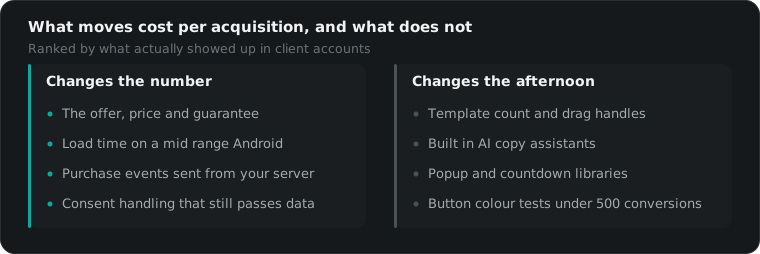
Everything else landing page builders sell you changes how pleasant your afternoon is. The drag handles, the AI copy assistant, the popup library. None of it changes the number on the invoice.
How much does page speed change your cost per acquisition?
Page speed changes cost per acquisition twice, and most people count only the first one. Slower pages lose visitors before anything renders. The part people miss is that a slow page fires fewer events too, which starves automated bidding of the data it optimises against.
So the platform bids worse on your behalf for weeks afterwards, while you sit reading a creative report trying to work out what changed.
Google publishes a library of documented cases with named companies attached. Vodafone Italy improved largest contentful paint by 31 percent and reported 8 percent more sales. Cdiscount reported 6 percent more revenue. Lazada reported a 16.9 percent lift in mobile conversions. All three sit in the Core Web Vitals business impact collection.
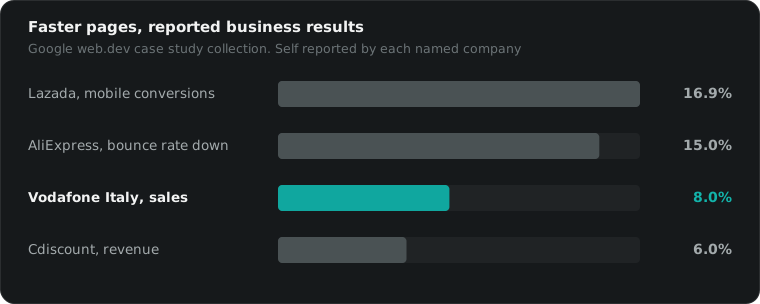
Be careful with what those numbers are. They are self reported, they measure different things, and not one of them is a controlled experiment. I would not put any single case in a deck. What makes them worth citing is that dozens of them point the same direction, which is more than most claims in this category manage.
Two thresholds to hold in your head: largest contentful paint under 2.5 seconds, interaction to next paint under 200 milliseconds. Measured on a mid range Android on a normal mobile connection.
That is the phone your traffic arrives on. Not the machine the page was designed on. Which is exactly why so many pages pass in the office and fail in the field.
Which builders break your conversion tracking?
The landing page builders that break tracking are the ones that will not let you edit the head, add a custom endpoint, or point events at a domain you control. Without those three permissions you are stuck with browser side tracking. That loses events on Safari and inside iOS apps.
The loss is invisible in the builder’s dashboard and extremely visible in your cost per result, which is the worst possible combination, because the tool reports success while your media budget quietly buys less.
The fix is firing purchase and lead events from a server, not only from the browser. Meta documents it in the Conversions API, including how to deduplicate against the browser pixel. Google has the equivalent through enhanced conversions and its own server side container.
Three checks before you commit to any tool:
- Can you add arbitrary script to the head and body? If not, most measurement setups are off the table.
- Can the form post to your own endpoint? The lead needs to hit your server, not only the builder’s database.
- Can you serve tags from a subdomain you control? That is what keeps first party cookies alive past seven days on Safari.
One more, if you sell into Europe. The tool has to let you gate tags behind a consent choice. Several of these do not, and bolting a banner onto a closed builder usually produces something that blocks precisely nothing while looking reassuring.
A builder that fails all three is not unusable. It is permanently blind. Nobody puts that in the comparison table, and I go through it properly in advertisement tracking.
The ten, and what is wrong with each one
Weakness stated rather than buried. Speed ratings are my own experience across client accounts, not a benchmark, and every one of these can be made slow by a careless build. The server side column is about whether the tool lets you do it at all.
| Tool | Speed out of the box | Server side events | The real weakness |
|---|---|---|---|
| Framer | Fast | Via your own container | Young ecosystem, you host on their terms |
| Carrd | Fastest | Barely | No testing, no real plumbing, will not scale |
| Webflow | Fast if disciplined | Via your own container | Embeds and interactions add weight quickly |
| WordPress, block theme | Depends entirely on you | Full control | Only as fast as whoever maintains it |
| Swipe Pages | Fast | Limited | Small vendor, fewer integrations |
| Leadpages | Medium | Limited | Dated output, weak custom code support |
| Shopify | Medium | Native to Meta and Google | Theme and app bloat compounds fast |
| Instapage | Medium | Partial | Enterprise pricing for features most accounts never use |
| Unbounce | Slow | Partial | Heavy builder runtime, positioned layouts hurt mobile |
| ClickFunnels | Slow | Locked down | Closed ecosystem, poor speed scores, hard to leave |
Two rows deserve a comment.
WordPress is the best answer for control and the worst answer for neglect, and the only thing that decides which one you get is whether a named person owns it. Unbounce has the strongest template and testing story here, which is precisely why people forgive its page weight for about a year longer than they should.
Price is the other thing these comparisons get wrong. The monthly fee is small next to the traffic you push through it. A tool at $99 a month that quietly costs you a tenth of your conversions is more expensive than one at $299 that does not, and at $20,000 of monthly spend that gap is around $2,000 a month, which is twenty times the difference in licence fee. Work it out in real money at your own spend before you choose on price.
Why do landing page builders matter less than the offer?
Landing page builders matter less than the offer because a fast page selling the wrong thing still loses. Across the accounts I run, changing the offer moves cost per acquisition by a multiple. Changing the builder moves it by a fraction, almost all of it through load time.
So ranking landing page builders is the fourth most useful thing you could do this month.
The right order is boring. Offer, then proof, then load time, then tool. Most teams run it backwards because choosing software feels like progress and rewriting an offer feels like admitting the last one was weak.
Here is the uncomfortable version. If your page converts at 1 percent and a competitor converts at 3, the gap is almost never the builder. It is price, or guarantee, or delivery time, or payment options, or the fact that they answer an objection you have never written down. No amount of button colour testing reaches any of that.
I would rather spend a week on the offer and ship the page on Carrd than spend it comparing landing page builders. Same argument I make about media buying: the buying is not where most of the money is won.
What I do about it
I do not sell page builds, so I have no reason to push you toward any of these landing page builders. What I do is refuse to run traffic to a page that takes six seconds on a phone. It wastes your budget and it makes my own numbers look worse than they are.
In practice the first two weeks of a new account are load time, server side events, and one uncomfortable conversation about the offer. Only after that does creative testing tell you anything you can trust.
You can see what I charge before speaking to anyone, including the exact percentage at your spend level. If you want 15 minutes to work out whether the page or the offer is your problem, bring the URL.
Questions people actually ask
Does the landing page builder really affect ad costs?
Indirectly, and mostly through load time. A slower page loses people before the pixel fires, which raises your cost per acquisition and also starves the platform of conversion events, so automated bidding optimises against thinner data. Google's own case study library documents an 8 percent sales increase at Vodafone Italy after a 31 percent improvement in largest contentful paint.
Which landing page builder is fastest?
In my experience Carrd and Framer produce the lightest pages, with Webflow close behind if you avoid heavy interactions and embeds. Builders that generate absolutely positioned layouts and ship a large runtime script, including Unbounce and ClickFunnels, are consistently slower on mid range Android hardware. Test your own page rather than trusting any vendor benchmark, including mine.
Can I fire server side conversion events from a landing page builder?
Sometimes, and it is the question most buyers forget to ask. WordPress and Shopify give you real server side options. Webflow and Framer can work if you route through your own tag manager server container. Closed builders that will not let you add a custom endpoint or edit the head reliably force you back to browser only tracking, which loses events on Safari and iOS.
Do I need A/B testing built into the builder?
Below roughly 500 conversions a month, no. You will not reach significance often enough for the feature to earn its price, and you will make decisions on noise. Spend that money on more offers and more creative instead. Above that volume, built in testing saves real engineering time and is worth paying for.
Is WordPress still a reasonable choice for landing pages?
Yes, if someone owns the maintenance. WordPress with a light block theme gives you the most control over markup, caching and server side tracking, and it is the cheapest option at scale. It becomes the worst option the moment a drag and drop plugin is installed on top of it and nobody measures the result.
How fast does a landing page need to be?
Aim for largest contentful paint under 2.5 seconds and interaction to next paint under 200 milliseconds, measured on a mid range Android phone on a normal mobile connection. Those are Google's published thresholds for a good experience. Most ad traffic arrives on exactly that kind of device, not the laptop your designer used.