Programmatic advertising: what you are buying

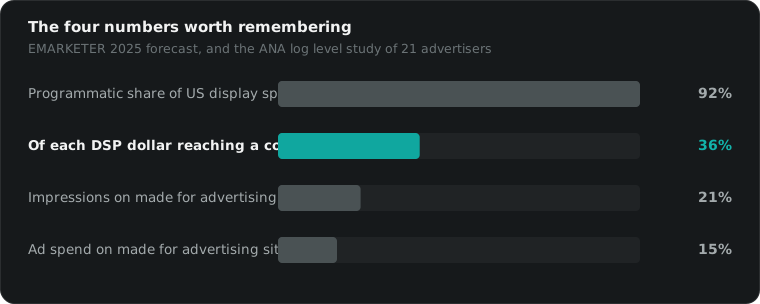
Programmatic advertising is the automated buying of ad space through real time auctions instead of a person ringing a publisher. It accounts for roughly 92 percent of US digital display spend. An ANA study of 21 advertisers found only 36 cents of every dollar entering a demand side platform reached a consumer.
Programmatic advertising is the automated buying of ad space, and that one phrase covers everything from a $2 CPM impression on a site you have never heard of to a six figure guaranteed deal with a named publisher. The gap between those two things is the whole problem.
Someone tells you they will run programmatic for you. That sentence is compatible with four different products, three different fee structures, and a tenfold difference in how much control you have. Worth knowing which one is in the proposal.
What is programmatic advertising, in one paragraph?
Programmatic advertising is software buying media from software. A person loads a page, the publisher sends a bid request describing the slot, and every buyer with a seat responds with a price. The highest bid wins and the ad renders. The whole exchange finishes in roughly 100 to 300 milliseconds.
The technical grammar it uses is the IAB Tech Lab’s OpenRTB specification, currently version 2.6. That is the mechanic. It replaced a phone call and an insertion order, and it now accounts for something like 92 percent of US digital display spend on EMARKETER’s numbers.
The important part is what it did not replace. The auction decides the price. It does not decide whether the page your ad landed on has a human reading it.
What can you buy, from open auction to private marketplace?
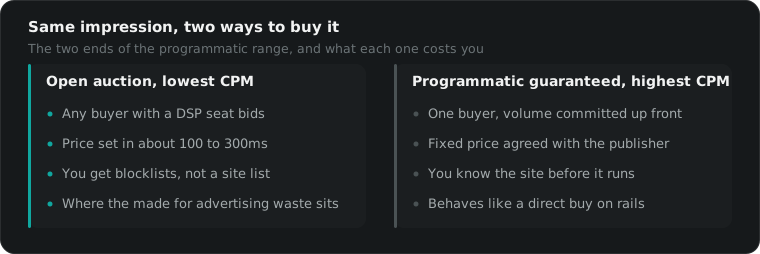
Four things, sold under one word. An open auction lets any buyer with a seat bid on the impression. A private marketplace restricts it to an invited list at a higher floor. A preferred deal fixes your price and gives you first refusal. Programmatic guaranteed commits volume, like a direct buy with a pipe attached.
The difference between them is who gets first look at the impression and how much you know about where it went.
| Deal type | Who can bid | Price | What you control | When it makes sense |
|---|---|---|---|---|
| Open auction | Anyone with a DSP seat | Lowest CPM | Almost nothing beyond blocklists | Broad reach, tolerant of waste |
| Private marketplace | An invited list, by deal ID | Higher floor | The publisher list, roughly | You care where the ad ran |
| Preferred deal | You, at a fixed price, first refusal | Fixed | Inventory and price, not volume | Repeatable placements on a few sites |
| Programmatic guaranteed | You only, volume committed | Highest | Everything, like a direct buy | Sponsorships, launches, CTV |
Most agencies quoting you a cheap CPM are quoting open auction. Most brands who feel burned by programmatic advertising were buying open auction and thought they were buying the fourth row.
Where does the money actually go?
This is the part nobody in the supply chain volunteers. The ANA ran a log level study across 21 large advertisers and published it in December 2023. Their finding was that only 36 cents of every dollar entering a demand side platform reached a consumer.
The rest disappears in stages. Demand side platform fee. Supply side platform fee. Data fees for the segment you targeted. Verification fees to check the impression was real. Then the part that is not a fee at all: impressions that were technically served and technically viewable, on sites built for no purpose other than absorbing ad budget.
The ANA put made for advertising sites at 21 percent of impressions and 15 percent of spend. The average campaign in that study ran across 44,000 domains. Nobody chose 44,000 domains. An algorithm did, because nobody told it not to.
There are two industry files that help, and both are free to check. ads.txt sits on a publisher’s domain and lists who is authorised to sell its inventory. sellers.json sits on an exchange and names the seller behind each seat. Together they let you see how many hops sit between your bid and the page. Every hop is a fee.
The buy side name for cleaning this up is supply path optimisation, which sounds like consultancy and is mostly arithmetic. Pick the shortest authorised path to each publisher you care about and cut the rest. On a mid sized account that alone is usually worth more than a month of bid tuning.
Where is programmatic growing, and where is it stalling?
Open web display is the part everyone means when they complain, and it is the part growing slowest. IAB and PwC put US display at $81.6 billion for full year 2025, up 9.8 percent. The same report put social at $117.7 billion, up 32.6 percent, and commerce media at $63.4 billion.
The growth is in the places with no cookie problem to begin with. Connected TV sells through the same auction mechanics with a device graph and a household, not a browser cookie. Retail media networks sell against a logged in purchase history. Digital out of home sells against a location and a time of day. All three are bought programmatically. None of them need a third party identifier.
That is the shift worth planning around in MENA specifically, where connected TV inventory in KSA and the UAE is now sold with the same deal IDs as web display, and where retail media on the large regional marketplaces is a cleaner buy than most open exchange supply.
Why programmatic advertising got harder to measure
Third party cookies did not die, so that is not the reason. Google confirmed in April 2025 that Chrome would keep them, then retired most of the Privacy Sandbox in October 2025. What you have instead is a split by browser, which makes frequency capping and reach reporting across the open web unreliable.
The story you have probably heard is that third party cookies died and took targeting with them. That is not what happened, and repeating it in 2026 marks you out.
Google said in April 2025 that Chrome would keep third party cookies and would not ship a new choice prompt. Then in October 2025 it retired ten Privacy Sandbox technologies, including Topics, Protected Audience and the Attribution Reporting API. So there is no cookie replacement, and there is no cookie deprecation either.
What you actually have is a split by browser. On StatCounter’s July 2026 numbers Chrome is about 68 percent of global browsing and still accepts third party cookies. Safari at 16 percent and Firefox at 3 percent have blocked them by default for years. So about a fifth of global browsing has been unaddressable by cookie the whole time, and your reach and frequency reporting has been quietly wrong about it.
The practical consequence for programmatic advertising is not that targeting stopped working. It is that frequency capping across the open web is unreliable, and your measurement leans much harder on advertisement tracking you own and on contextual advertising signals that do not need an identifier at all.
Should you run programmatic advertising at all?
Honest answer for most brands reading this: probably not yet. Open web programmatic advertising is a scale product, and the fee stack only pays for itself above roughly $20,000 a month. Below that, Google Display buys much of the same inventory with no seat fee, no minimum spend and one less party taking a cut.
It earns that fee stack when you have enough budget that a one percent efficiency gain pays for the tooling, and enough brand demand that reach has value on its own. Below that line you are paying a DSP fee, a data fee and a management fee to reach inventory you could have bought more directly.
Three things to insist on if you do run it.
- A domain allowlist, not a blocklist. A few hundred sites will reach most of your audience. Start there and expand, rather than starting at 44,000 and pruning.
- Log level or placement level reporting, monthly. If a partner will not show you where the impressions ran, that is the answer to the question.
- The fee stack written down. Media cost, DSP fee, data fee, verification fee, agency fee. Five numbers. Any partner who gives you one blended number is hiding at least one of them.
That last point is the same argument we make about media buying fees generally. A blended number is a number designed not to be checked.
What we do about it
We run programmatic advertising when the budget justifies it, and we say so when it does not. For most accounts under $20,000 a month the money does more work in search, social and retail media, where the feedback loop is days rather than weeks.
Our pricing is published with the actual percentages, so you can work out the fee on your own spend before you speak to anyone. There are real accounts and what they returned if you want the work before the conversation, and 15 minutes is usually enough to tell whether programmatic advertising belongs in your plan this year or next.
Questions people actually ask
Is programmatic advertising the same as display advertising?
No. Display is a format, a banner or a rich media unit on a web page. Programmatic is a buying method, an automated auction. You can buy display programmatically, and you can buy video, audio, connected TV and digital billboards the same way. Almost all display is now bought programmatically, which is why the two words get used as if they mean one thing.
What is the difference between an open auction and a private marketplace?
An open auction is available to any buyer with a seat on a demand side platform, and inventory quality varies wildly. A private marketplace is a deal ID a publisher gives to a named list of buyers, usually at a higher floor price, on inventory the publisher has agreed to make available. You pay more per thousand impressions and you know where the ad ran.
How much does a programmatic campaign cost to run?
Open web CPMs sit roughly between $2 and $12 depending on market, format and targeting, and connected TV runs far higher. On top of the media you pay a demand side platform fee, often 10 to 20 percent, plus data and verification fees. Ask any partner to show you the media cost and the fee stack as separate lines before you sign.
Do I need a demand side platform, or can I use Google Ads?
Google Ads Display buys a subset of the same inventory with no seat fee and no minimum spend, so start there. A separate demand side platform makes sense once you need private marketplace deals, connected TV, log level reporting or supply path control. Below roughly $20,000 a month on the open web, a DSP seat costs more in fees and management than it returns.
Did the end of third party cookies kill programmatic advertising?
It did not, because it did not happen. Google confirmed in April 2025 that Chrome would keep third party cookies with no new prompt, then retired most of the Privacy Sandbox APIs in October 2025. Safari and Firefox still block by default, so open web addressability is fragmented by browser rather than gone. Contextual and first party signals cover the gap.