Media buying vs media planning, and who does what

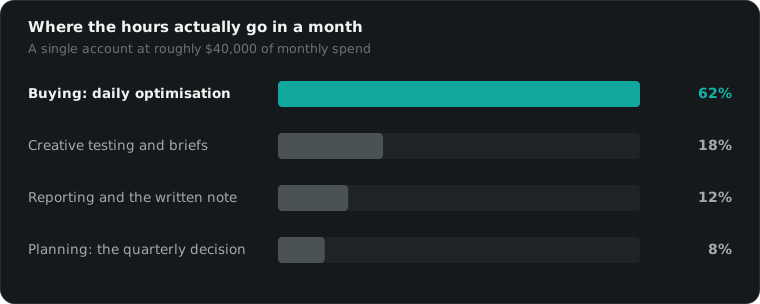
Media planning decides which platforms get the budget and why. Media buying spends it and adjusts daily. Planning happens roughly once a quarter and produces a document. Media buying happens every morning and never finishes. At a $40,000 account, buying is about 62 percent of the work.
Media buying and media planning get used as if they mean the same thing. They do not, and the confusion costs real money, because you end up paying for one while expecting the other.
The short version
Media planning decides which platforms get the money, which audiences to reach, and what the spend has to return. Media buying builds those campaigns, puts the money in, and moves it daily as the results arrive. One of them produces a document each quarter. The other is an operating job with no end date on it.
Media planning is deciding. Which platforms, which audiences, how much money, and against what number.
Media buying is doing. Building the campaigns, putting the budget in, and changing it as the results come back.
Planning happens once a quarter, or when something big changes. Buying happens every morning.
Most of the money gets lost in the gap between the two, when the plan says one thing and nobody checks whether the account is doing it.
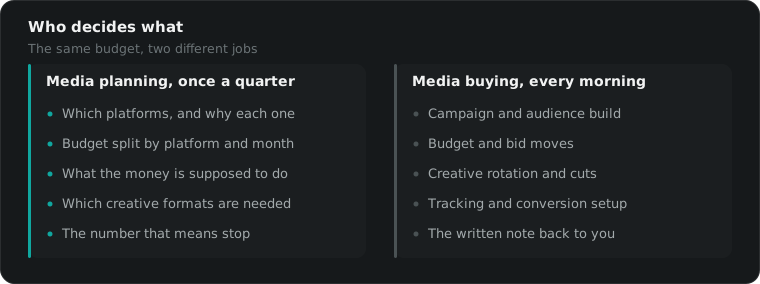
What does media planning actually decide?
A media plan decides five things: what the money is for, which platforms get it, how much each one gets and in which month, what creative has to exist first, and what number would make you stop spending. A plan worth the name answers all five with figures rather than adjectives.
- What the money is for. Sales, leads, installs, or awareness. Pick one. A plan that says “grow the brand and drive sales” has not decided anything, it has listed hopes.
- Where it goes. Which platforms, and why each one is on the list. “Because everyone is on TikTok” is not a reason. “Because our buyer is 24 to 34 and our creative is already vertical” is.
- How much, and when. Split by platform and by month, not one annual number that nobody can act on.
- What creative is needed. Vertical video, feed statics, carousels. This is the part that gets skipped and then blocks everything for three weeks while someone finds a videographer.
- What would make you stop. The number at which budget comes out of a platform. Almost nobody writes this down and everybody should.
That last one is the difference between a plan and a wish list. If there is no number that triggers a stop, the plan cannot be wrong, which means it cannot be right either.
What does media buying involve day to day?
Media buying is the daily work of running live campaigns. Checking what spent overnight, cutting the ad sets that burn without converting, moving budget toward what is working, watching frequency, and confirming that conversions still track. It is the unglamorous half of the job, and it is where the money is actually won or lost.
The detail under each of those is where the skill sits. Move budget before the platform’s own optimisation gets there, not after. Watch frequency, because the same person seeing your ad nine times is not reach, it is annoyance. Check conversions every morning, because pixels break quietly and you can lose a week before you notice.
Then the slower work. Briefing the next round of creative from what the last round taught you. Rebuilding audiences that have gone stale. Rewriting copy that used to convert and stopped.
None of that appears in a media plan. All of it decides whether the plan works.
Which one are you actually paying for?
This is where most brands get caught. You commission a plan, feel good about the document, and then discover that nobody is doing the daily work. Or you hire someone to run ads and assume strategy is included, and six months later nobody can tell you why LinkedIn is on the list.
Here is the honest split at different budgets.
| Monthly ad spend | Planning needed | Buying needed | Who should do it |
|---|---|---|---|
| Under $5,000 | A conversation | Daily, but light | You, honestly |
| $5,000 to $25,000 | Once a quarter | Daily | One person doing both |
| $25,000 to $100,000 | Quarterly, written | Daily, several platforms | A specialist, or a small team |
| Above $100,000 | Monthly review | Daily, plus creative pipeline | A team with split roles |
The row people ignore is the first one. Below about $5,000 a month there is not enough data for anyone to optimise against, and an agency fee on top makes the maths worse, not better. We tell people this on the call and lose the work. It is still the right answer.
The other thing worth checking is how the fee is shaped. A percentage of spend pays your agency more every time it spends more, which is a strange incentive to hand someone. A flat fee at the bottom of the range does not do that. Ours starts at $1,095 under $2,500 of monthly spend, and it is published.
Why the two get confused
Media buying and media planning get confused because agencies sell them as one package, and because the word “strategy” is easier to charge for than the word “maintenance”. A media plan is a satisfying deliverable. Media buying is a person changing budgets on a Tuesday morning and writing you a note about it.
One of those has charts and can be presented in a meeting. It feels worth $8,000. The other one is what actually moves the number.
The second reason is historical. Buying used to mean ringing a publisher and taking a slot in next month’s issue, once, well in advance, which really was a separate procurement job with a deadline. On Meta or Google you are still buying, but the auction runs in milliseconds and it runs again every time someone opens the app. The purchase never stops, so neither does the buyer.
How do you tell if your media buying is any good?
Ask whoever runs your account four questions. What did you change last week and why. What is not working right now. What number would make you tell me to stop spending on a platform. And what did a customer cost, all in, including your fee. Good media buying answers all four with figures.
- Last week’s changes. A good answer is specific and unglamorous. A bad answer is “we are letting the algorithm learn,” three weeks running.
- What is not working. Anyone who says everything is working is not looking hard enough.
- The stop number. If there is no number, there is no plan behind the buying.
- Cost per customer, all in. Including the fee. If the answer skips the fee, the number is decoration.
You do not need to understand the platform to ask these. You need to notice whether the answers have numbers in them. Anyone who cannot answer the third one has never had to defend the spend to anybody.
What we do about it
We do both, and we do not charge separately for the thinking. Planning is one conversation on the way in and a review each quarter. The rest is media buying, done every morning, with a written note every two weeks in language you already speak.
You can see exactly what that costs, including what the percentage works out to in real money, before you talk to us. There are real accounts and what they returned if you want to see the work first. And if you would rather just ask, 15 minutes is usually enough to tell whether it is worth doing.
Platform documentation worth reading yourself: Google’s own page on Smart Bidding, and Meta’s developer docs on the Conversions API, which is the tracking piece most accounts get wrong. Both are written by the people who built the auction, which makes them more useful than most agency blogs on the subject.
Questions people actually ask
Is media buying the same as running ads?
Mostly, yes. Media buying is the day to day work of putting budget into ad platforms and adjusting it: campaign setup, bids, budgets, audiences, creative rotation and cutting what is not working. The term comes from an era when you literally bought slots from a publisher. On Meta or Google you are still buying, the auction just runs in milliseconds.
Do I need a media planner if I only run Meta ads?
No. On a single platform with one product, planning is a short conversation, not a role. You need planning as a separate exercise once you are across three or more platforms, or when the budget is large enough that putting it in the wrong place costs more than the time spent deciding.
What does a media plan actually contain?
The objective in numbers, the audiences, the platform split with a reason for each, the budget by platform and by month, the creative formats needed, how success is measured, and what would make you stop. If a media plan does not say what would make you stop, it is a wish list.
Can the same person do both?
At small and mid budgets, yes, and usually better. The person spending the money daily sees things a planner working from a spreadsheet never will. The split into two roles exists at large agencies for staffing reasons, not because the work genuinely divides.
What should media buying cost?
Most agencies charge 10 to 20 percent of ad spend, or a retainer of $2,000 to $10,000 a month. Below roughly $5,000 of monthly spend, neither model makes sense and you are better off learning the platform yourself. Above that, ask what the percentage works out to in real money before you sign.