Digital marketing tools I pay for, and what I cut

Most accounts need four digital marketing tools, not forty: the ad platforms themselves, one analytics property, one server side tracking layer, and a spreadsheet. Everything else sells convenience. On a $10,000 month, software is about 4 percent of the budget, and it is never the reason an account works.
Most lists of digital marketing tools are written by people who get paid when you click through. This one is not. It is what is open on my screen on a Tuesday morning, what I cancelled, and what the product pages quietly leave out.
14 years in, the stack got smaller rather than bigger. That surprised me too.
What digital marketing tools do you actually need?
You need four things: the ad platforms themselves, one analytics property, one server side tracking layer, and a spreadsheet you trust. That covers any business spending under $50,000 a month. Every other product sells convenience, reporting polish or a dashboard, and none of those change what an auction charges you.
The ad platforms are free. Meta Ads Manager and Google Ads cost nothing to open, and they are where every real decision gets made. People go shopping for a dashboard before they have written a second ad.
Those four digital marketing tools are also the only ones a new hire has to learn. That matters more than it sounds. Every extra login is a place for a number to go stale without anyone noticing.
Analytics is Google Analytics 4. It is free, it is irritating, and it is the shared language every other tool ends up speaking.
The tracking layer is the part most accounts skip. Browser pixels lose events to ad blockers, to Safari and to people who close the tab. Meta’s Conversions API sends the same event from your server and deduplicates it against the pixel. That is not a nice to have at spend, it is the difference between optimising on real data and guessing.
The spreadsheet is not a joke. Every account I have run for over a year has a sheet with spend, revenue and cost per purchase by week. It exists because no platform shows all three honestly in one place.
Which analytics tools are worth the setup time?
Two, in this order. Google Analytics 4 first, because it is free and every other product eventually asks for its data. Then the reporting inside Meta and Google Ads, which will disagree with GA4 and always will. Standard GA4 properties keep user level data for 2 or 14 months, so choose before you need it.
The disagreement is not a bug. Meta credits a conversion to the person who saw the ad. GA4 credits the last click. Both are right inside their own model and neither is the truth.
Pick one number to manage against, and use the other for direction only. On most of our accounts the managed number is revenue in the store platform, divided by total spend. It is blunt and it does not lie.
Analytics is also where most digital marketing tools get their numbers, which is why a broken GA4 setup poisons every dashboard downstream of it. Fix the source before you buy the chart.
The retention setting is the one people find out about too late. Google’s own page on data retention sets standard properties at 2 or 14 months for user level data, with 360 going up to 50. Change it on day one, because it does not backfill. If any of this matters to you, the deeper version sits in our post on advertisement tracking.
What does an all in one platform not do?
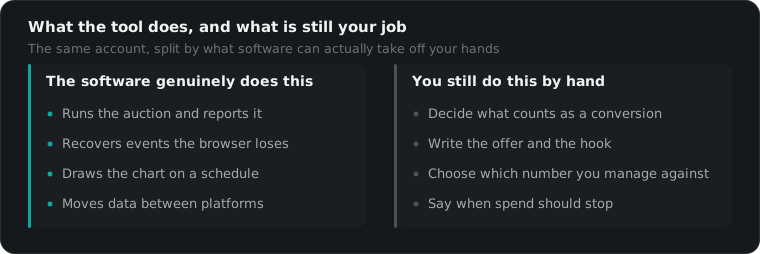
An all in one platform will not buy media, will not write your creative, and will not tell you that its own attribution model favours the channels it sells you. It moves data between boxes and draws the chart. That is genuinely useful. It is also the part of the job that takes the least skill.
The attribution point deserves the awkward version. Every suite with an attribution feature is marking its own homework. If the tool sells email, email gets credit. If it sells on site popups, popups look wonderful. None of this is fraud, it is just a model, and the model was chosen by someone with a quota.
The second thing they do not mention is the migration. Moving a list, a tag setup and six years of history into a new platform takes a fortnight of somebody’s life. Budget it or do not start.
The third is that the integration you need is often on the roadmap rather than in the product. Ask for it by name before you sign, not after.
There is a regional version of this that costs Gulf clients real money. Most all in one digital marketing tools handle Arabic badly. Right to left email templates break, Arabic segmentation trips over spelling variants of the same name, and local payment gateways in KSA and Egypt are rarely on the connector list. Test with your own data in Arabic before you migrate anything.
Which digital marketing tools did I stop paying for?
Four, over the last two years. A competitor ad spy subscription, a rank tracker, a paid reporting dashboard we used on two accounts, and an all in one CRM nobody logged into after month three. Together they were roughly $400 a month, and cutting them changed no client result in either direction.
The ad spy tool went first. The Meta Ad Library shows every active ad on the platform for free, and knowing which creative a competitor runs tells you nothing about whether it works for them. We used the paid version to win zero arguments.
The rank tracker went because we do not sell SEO. It was bought during a month when someone thought we might.
The dashboard was harder. It was genuinely nice. It also cost more per month than the hours it saved on two accounts, and Looker Studio does the Google half for nothing.
The CRM went because the client already had one. Two systems holding contacts is worse than one bad system holding contacts.
The pattern in all four is the same. We bought digital marketing tools to answer a question we were not being asked. Nobody ever cancelled a retainer because our dashboard was ugly. They cancel when cost per purchase climbs for six weeks and nobody says so.
| Tool category | What it genuinely does | What you still do by hand | Worth paying for at |
|---|---|---|---|
| Ad platforms | Runs the auction, reports the result | Every decision inside it | Always, they are free |
| Analytics | Says what happened after the click | Deciding what counts as a conversion | Always, GA4 is free |
| Server side tracking | Recovers events the browser loses | Mapping events, then testing them | Above roughly $10,000 a month |
| Reporting dashboards | Draws the chart faster than you can | Reading it, writing the note | Three or more platforms |
| Creative production | Makes the file | The idea, the offer, the hook | Always, and cheaply |
| Competitor spy tools | Shows you a competitor’s ads | Deciding whether any of it matters | Rarely, cancel after a month |
Where does the money actually go?
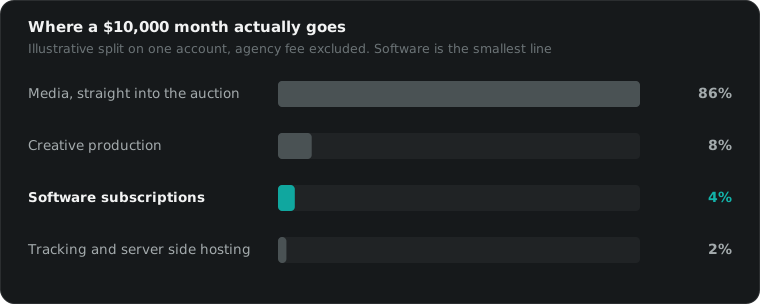
Into the auction. On an illustrative $10,000 month, roughly 86 percent goes straight to the platforms as media, about 8 percent to making the creative, around 4 percent to software, and the rest to tracking and hosting. Software is the smallest line on the page and the one people research hardest.
That ratio is the whole argument. An extra $200 a month of tooling has to move the media 2 percent to break even, and almost none of it does. The same $200 spent on one more piece of decent video usually does.
Creative is the underfunded line everywhere I look. Accounts arrive with six subscriptions and three ads. The fix is never a seventh subscription.
There is one honest exception. Below about $5,000 of monthly spend, digital marketing tools and agency fees both stop making sense, because the fixed cost swallows the media. At that level you are better off learning Ads Manager yourself for a few months. We say this on calls and lose the work.
What do we use, and what does it cost?
Ads Manager, Google Ads, GA4, a server side tracking setup, Looker Studio, a spreadsheet, and whatever the client already owns for email and social. Paid subscriptions across the whole agency run under $300 a month. The cost that matters on your account is the media and the fee, not the software.
Our fee is published, which nobody else in the category does. It is $1,095 flat under $2,500 of monthly spend, then a marginal rate stepping 10, 9 and 8 percent as the budget grows, landing at 10.4 percent all in at $50,000. You can work out your own number before you speak to anyone here.
Two related posts if you are picking a stack: what email marketing software does and does not fix, and which social media management tools are worth a seat. If you would rather just ask which digital marketing tools your account needs, 15 minutes usually settles it.
Questions people actually ask
What digital marketing tools does a small business actually need?
Meta Ads Manager and Google Ads, both free. Google Analytics 4, also free. One server side tracking layer, which is a few dollars of hosting or an app in your store platform. Then a spreadsheet with spend, revenue and cost per purchase by week. That covers almost every business spending under $50,000 a month.
Is an all in one marketing platform worth it?
Only when the alternative is five separate logins that nobody reconciles. All in one platforms are convenient and their attribution model is their own, which means it flatters the channels they sell. Use their reporting for direction and keep the platform numbers and your bank statement as the numbers you manage against.
How much should I spend on marketing software each month?
As little as possible until the spreadsheet genuinely hurts. On accounts under $10,000 of monthly ad spend, anything above roughly $150 a month in subscriptions is usually buying a nicer chart. Above three platforms and two people, a reporting tool starts to pay for itself in hours saved.
Do I need a paid reporting dashboard?
Not until you are reporting on three or more platforms every week. Looker Studio is free and connects to Google properties without a fee. The paid connectors earn their money when you need Meta, TikTok, Snap and Google in one table on a schedule, and not before that.
What is the most overrated tool category?
Competitor ad spy tools. The Meta Ad Library shows every active ad on the platform for nothing, and knowing what a competitor runs almost never tells you why it works for them. We paid for one for a year and used it to win exactly zero arguments about our own account.