Best marketing campaigns, judged on money

The best marketing campaigns worked because they bought something durable: a brand name people typed directly, a purchase moment, or a habit inside a product. Dumb Ways to Die won a record five Cannes Grand Prix in 2013. Almost none of these campaigns could reach the same audience today.
The best marketing campaigns get written up the same way every year, and the list never changes. Dove, Nike, Apple in 1984, Old Spice. You have read that article. It tells you nothing about what to do on Monday morning.
I buy media for a living. So the only questions I find useful about the best marketing campaigns are what one actually bought, what the purchase cost, and whether the same thing is still for sale. The third answer has changed the most.
What makes the best marketing campaigns actually work?
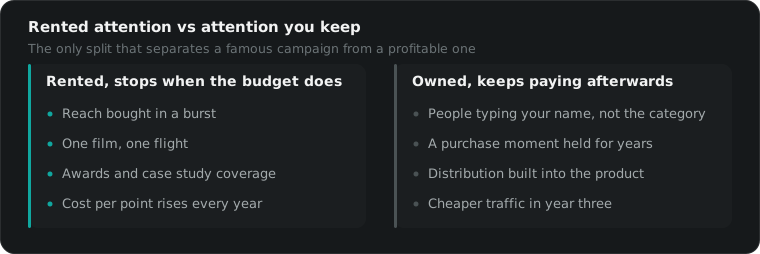
The best marketing campaigns buy something that keeps paying after the media stops. A name people type directly into a browser. A purchase moment the brand owns in memory. A habit built inside a product. Everything else is rented attention, and rented attention disappears in the same week the budget does.
That is the whole test. Three years after the flight ended, is there still an asset on the balance sheet?
- Direct demand. People who search your name instead of your category. This is the cheapest traffic that exists, and campaigns that create it are the only ones that genuinely lower long term cost.
- An owned occasion. Hunger, Ramadan, Friday night. If the brand is the default answer to a moment, the moment does the selling.
- A distribution habit. The rarest one. The campaign lives inside the product, so users carry it for free.
Everything else in the famous lists is a good film with a media plan behind it. Good films are worth having. They are not an asset.
Which marketing campaign examples still hold up?
Four of the best marketing campaigns hold up under a buyer’s reading, and none are the ones listicles pick. Compare the Market’s meerkats, the Snickers hunger line, Spotify Wrapped, and Zain’s Ramadan films. Each bought a different thing. Only two of them bought something a brand today could realistically go and buy.
Compare the Market, 2009. A price comparison site sitting fourth in its own category, losing a paid search auction it could not win on budget. So it built a mascot with a name close to the brand, spent heavily on television, and moved buyers from typing a generic query to typing the site name. That is a media arbitrage dressed as a creative idea. It is the most instructive campaign on this list and almost never appears on them.
Snickers, 2010 onward. One line, tied to one physical state, rolled across dozens of markets for fifteen years. The cost per year is unremarkable. The cost per year of relaunching a new idea every twelve months is much worse, and that is the comparison nobody runs.
Spotify Wrapped. No media buy at all in the traditional sense. The product generates the creative, users post it, and the feed distributes it. Spotify said the 2025 edition reached 200 million engaged users in its first day. You cannot copy this unless you already hold the data and the app.
What did the best marketing campaigns cost to run?
Almost nobody publishes the real number, and the figures that circulate usually come from the agency that made the work. What you can compare honestly is the shape of the spend: how much goes into production, how much into media, and over how many years the thing amortises. That shape predicts profitability better than the budget total.
| Campaign | What it bought | Spend shape | Still buyable in 2026 |
|---|---|---|---|
| Compare the Market meerkats | Direct brand search | Heavy TV, sustained for years | Partly, at much higher cost |
| Snickers hunger line | An owned purchase moment | Moderate, spread over 15 years | Yes, if you commit |
| Spotify Wrapped | Free distribution by users | Near zero paid media | Only if you own the data |
| Zain Ramadan films | One calendar moment a year | High production, one burst | Yes, in MENA |
| Dumb Ways to Die | Awards and reach | Low production, viral pickup | No, the feed changed |
The row that matters is the last column. A campaign budget is not the interesting number. Whether the inventory that made it work still exists is.
Which Gulf campaign deserves more attention?
Zain’s Ramadan films deserve more attention than most of the best marketing campaigns, and the trade press outside the region ignores them. Every year the Kuwaiti operator releases one long film into the single moment when Arab households watch television together. It reaches tens of millions of views across the Gulf and North Africa. The mechanic is calendar ownership.
Ramadan in MENA is not a seasonal uplift. It is the season. Television viewing spikes, screen time after iftar spikes, and every large advertiser in the region is buying the same three weeks. Zain’s answer was to stop competing on media weight and compete on the film itself, so the earned pickup does the reach that money could not buy at that price.
The honest part is what is missing. Zain has never published what the films did to churn, to ARPU, or to net adds. The 2018 film also drew as much criticism as praise, which is a real risk when your campaign is a political statement in twelve countries with twelve different politics. If you want the version of that argument in full, it sits closer to controversial ads than to a case study.
I still tell Gulf clients to study it, because the underlying move is available to anyone. Pick the moment your customer already stops for, and own it every year rather than buying it once.
Why would most of these campaigns fail today?
Most of the best marketing campaigns would fail because the audience they bought no longer sits in one place. In May 2026 streaming took 48.6 percent of US television time, against 20.4 for cable and 19.2 for broadcast. Buying a country inside one week used to be a media plan. Now it is a procurement exercise across a dozen sellers.
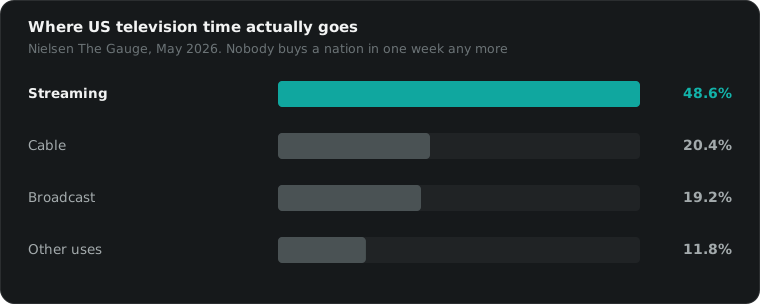
The Nielsen Gauge for May 2026 is worth reading directly rather than through a trend deck. Three things follow from it for anyone planning an ad campaign.
- Reach costs more per point. The same gross rating points now come from more sellers, more contracts and more measurement gaps.
- Frequency is harder to control than to buy. Deduplicating a person across streaming, social and the open web is the actual job, and most plans quietly skip it.
- A single film is a weaker asset. Feeds reward volume and variation, so one perfect execution is a worse fit than fifteen decent ones.
The exception is the Snickers pattern. Consistency over years survives fragmentation better than brilliance in one quarter, because memory is the one distribution channel nobody has unbundled.
Award winning and profitable are not the same thing
Dumb Ways to Die won five Grand Prix, eighteen Gold, three Silver and two Bronze Lions in 2013, which made it the most awarded campaign in the sixty year history of Cannes. It passed fifty million YouTube views. Its effect on train safety has been argued about since, and the strongest claims came from the people who made it.
That is not a criticism of the work, which is genuinely good, and it belongs on any list of the best marketing campaigns. It is a warning about the evidence chain. An awards jury is judging craft and a case film. A finance director is judging incremental margin against what would have happened anyway. Those two panels reward different things, and a campaign can score very well with one while doing nothing measurable for the other.
You can read the official Cannes result and then try to find an equally solid source for the sales or safety effect. The asymmetry tells you everything about how this industry reports itself.
So when someone pitches you a campaign by naming the awards it might win, ask what number it is supposed to move and by when. If the answer arrives without a figure, the pitch is for the agency’s reel, not your account.
What we do about it
We do not run award campaigns. We run accounts, which means the work is buying, testing and cutting, and the interesting output is a cost per customer rather than a case film. Most of what we learn from the best marketing campaigns is structural: pick one moment, say one thing, and repeat it long enough to become the default answer.
That thinking sits underneath the daily work described in media buying, and it is why we argue about creative volume before we argue about targeting.
You can see what this costs before you speak to anyone, including the exact percentage at your spend level. There are real accounts and what they returned if you would rather see the work than the theory. And if you want 15 minutes to ask whether a campaign is even the right shape for your budget, book it.
Questions people actually ask
What actually makes a marketing campaign successful?
A campaign is successful when it buys something that keeps working after the media budget stops. That is usually one of three things: a brand name people type directly instead of searching a category, a purchase occasion the brand owns in memory, or a habit built inside the product itself. Reach on its own is rented, and it expires the week you stop paying.
Are award winning campaigns usually profitable?
Often not, and the two get confused constantly. Awards are judged on craft, originality and the case film. Profit is judged on incremental sales against what would have happened anyway. Dumb Ways to Die is the most awarded campaign in Cannes history and its actual safety outcome is still argued over. Ask for the payback number, not the trophy count.
How much did famous campaigns cost?
Almost nobody publishes the real figure, and the numbers that circulate usually come from the agency that made the work. What you can reason about is the shape of the spend. A long running platform like the Snickers hunger line amortises over fifteen years and dozens of markets. A single viral film is cheap to make and expensive to repeat.
Can a small brand copy these campaigns?
Not directly. Most of the famous campaigns bought national reach at a time when four channels carried most of the audience. That inventory no longer exists in the same form. What a small brand can copy is the mechanic: pick one purchase moment, say one thing about it, and keep saying it for years instead of relaunching every quarter.
Which Gulf campaigns are worth studying?
Zain's annual Ramadan films are the clearest example in the region. One film a year, released into the single moment when Arab audiences watch together, distributed across television and YouTube, generating tens of millions of views. The mechanic is calendar ownership. The gap is that Zain has never published what any of it did to churn or revenue.
Should I run a brand campaign or performance ads?
Below roughly $5,000 of monthly spend, run performance and skip the brand campaign, because you cannot afford enough frequency for brand work to register. Above that, the split matters more than the label. The useful question is what share of your budget is talking to people who already know you, and whether that share is quietly growing.