What a CRM system really does for your ad spend

A CRM system is what lets you send real outcomes back to Meta and Google so their bidding optimises towards revenue instead of form fills. Google reports a median 10 percent lift in measured conversions when advertisers combine first party data with click IDs. Without it, you are buying leads blind.
A CRM system earns its place in a business the day someone asks which ads actually produced revenue and nobody can answer. That question sounds like a reporting problem. It is not. It is a buying problem, and it is the reason a lead generation account can run for a year and never get better.
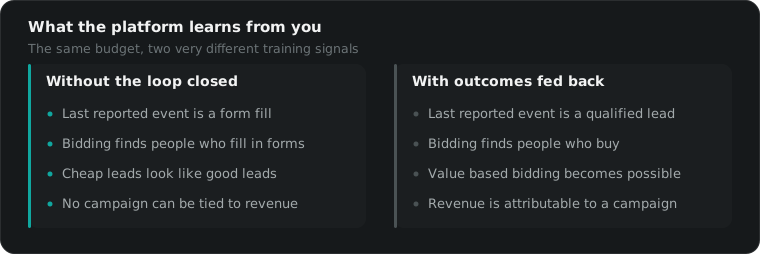
Here is the mechanic, because most articles on this subject skip it. Meta and Google do not optimise towards your revenue. They optimise towards the last thing you told them about. If the last thing you told them about is a form submission, that is what they will get you more of, including all the ones that never answer the phone.
Why a CRM system decides what your ads optimise for
The bidding systems on both platforms are trained on outcomes you report back. Report a form fill and the algorithm learns to find people who fill in forms, which is a real skill and not the one you are paying for. Report a closed deal with a value on it and the target changes completely.
That feedback loop needs somewhere to live between the click and the sale, and that place is a CRM system, which is the entire argument for owning one. It holds the lead while a human works it, records what happened, and hands the result back to the platform weeks after the click that created it. Nothing else in a typical stack does that job.
Google publishes a number on this and it is the most useful figure in the whole subject. On its offline conversion import documentation, Google states that advertisers who combined first party data with click IDs saw a median 10 percent increase in conversions compared with standard offline conversion imports. Median, not average, which is the honest way to publish it.
What are the 7 reasons, ranked by what they cost you?
Most lists about a CRM system put “better organisation” at the top. That is the reason with the least money attached to it. Ranked by what each one is actually worth to a business spending money on ads, in my experience running these accounts, the order runs almost exactly the other way round.
- Your bidding gets a real target. Optimising towards qualified leads instead of form fills changes which people the algorithm goes looking for.
- You find out which campaign made money, not which one made cheap leads. Those are frequently different campaigns.
- You can bid by value. Google’s own figure for advertisers moving from target CPA to target ROAS is a median 14 percent increase in conversion value, though that stat is general rather than lead generation specific.
- Signal survives the browser. A server side feed from your CRM does not care about a consent banner or an ad blocker.
- Sales stops arguing with marketing. One record, one timestamp, one source of truth about whether the lead was any good.
- You keep your history when a platform changes. Ad accounts get reset, agencies get changed, your CRM is yours.
- Nothing falls through. The organisational reason. Real, and worth the least.
The first three are worth more than the other four combined, and all three depend on the same thing: whether the lead record can be matched back to the click that created it.
What a media buyer actually needs from a CRM system
This part is short and it is the whole brief. Four fields decide whether an expensive CRM system is useful to an advertiser or just tidy. Miss any one of them and the loop breaks silently, which is worse than it breaking loudly, because the reports keep arriving and they keep being wrong.
| What it stores | Why it matters |
|---|---|
| The click ID at form submission | Without it nothing can be matched back to an ad |
| Stage timestamps | Lets you see how long real deals take, and cut on the right window |
| A revenue field | The input for value based bidding, not a nice to have |
| An export or webhook out | Manual CSV uploads stop being viable, see below |
On click IDs, be precise. Google issues gclid, and gbraid and wbraid on app to web journeys. Meta issues fbclid in the landing page URL, which becomes fbc in the format its API expects. UTM parameters are not any of these. UTMs are a self imposed analytics convention that tell your own reporting where traffic came from. They cannot be used to report a conversion back to a platform. A surprising number of setups collect only UTMs and wonder why nothing matches.
For Meta lead ads specifically, Meta’s conversion leads documentation says to store the 15 to 17 digit Lead ID in your CRM and send it with each event. It also states a threshold worth knowing before you plan this: at least 200 leads a month, with a lead to qualified rate between 1 and 40 percent, and roughly a month before it is worth judging.
What changed for offline conversions in June 2026?
If you are building this now, one date matters more than anything else in this article. Google is moving offline conversion import and enhanced conversions for leads onto its Data Manager API. From 15 June 2026 those uploads are blocked in the Google Ads API for developers and accounts not already allowlisted, which returns an explicit not allowlisted error.
In plain terms: the old integration path is closed to newcomers. If you are choosing a CRM system or a connector this year and it only talks to the legacy endpoint, it will not work for you, and it may work fine for the agency next door who was already using it. That is a genuinely confusing failure mode and it is worth asking any vendor about directly.
This is also the practical argument for a webhook out of your CRM system rather than a spreadsheet workflow. Ingestion endpoints change. A system that can post an outcome to whatever URL is current survives that. A monthly CSV upload into a deprecated path does not.
Is any of this still about cookies?
No, and an article that says otherwise is dated in a way that should make you distrust the rest of it. Google confirmed in April 2025 that it would keep third party cookies in Chrome, then began retiring the Privacy Sandbox APIs themselves after adoption stalled near 13 percent of page loads.
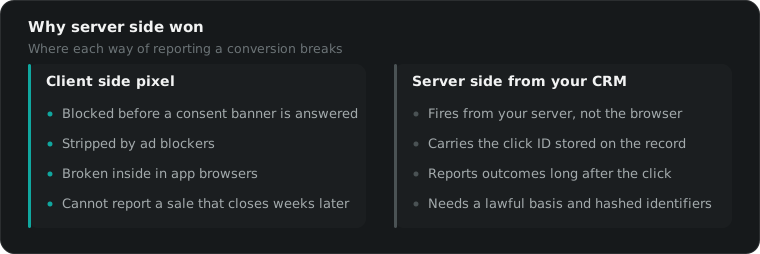
The signal loss that lead generation advertisers actually live with was never mainly cookies. It is consent banners that block tags before they fire, ad blockers, and in app browsers that break client side tracking. Apple’s tracking transparency prompt, which sits at roughly a 35 percent opt in rate industry wide, applies to apps rather than to a web form on your website.
Every one of those problems is a client side problem. A server side feed out of a CRM system is not client side, which is the actual reason this approach won, and it would have won regardless of what Chrome decided about cookies.
What about privacy law in the Gulf?
Short version, and deliberately short, because this is the section where being roughly right is worse than saying less. Sending customer data to an ad platform is a data transfer and it has rules attached, which vary by where your customers are rather than by where you are.
In the EEA, consent is required and Google operationalises it through Consent Mode signals covering ad data use and ad personalisation. The UAE has had a personal data protection law in force since January 2022 requiring consent and putting conditions on transfers outside the country. Saudi Arabia’s has been enforceable since September 2024, regulated by SDAIA.
Both platforms require personal identifiers to be hashed before you send them. Hashing is a technical requirement, not a legal one, and it does not by itself remove the need for a lawful basis. If a vendor tells you hashing makes consent unnecessary, get a second opinion from someone with a practising certificate.
If you want a straight read on whether your current setup can actually measure what your ads produce, that is a 15 minute conversation. Book a call, or see what it costs first. If the problem is further upstream and you are still deciding what to measure, start with what a conversion goal should be.
Questions people actually ask
Do I need a CRM system if I only run a few ads?
If you sell online and the sale finishes on your website, no, your checkout already reports the outcome. If you generate leads and the sale finishes on a phone call, then yes, and the threshold is lower than people think. Meta's own guidance for its lead optimisation asks for at least 200 leads a month before the system has enough to learn from.
Which CRM system is best for a business running paid ads?
Any of them, as long as it does four things. It has to store the click ID from the ad platform against the lead, timestamp the stages a lead moves through, hold a revenue figure when the deal closes, and let you push that back out by export or webhook. A cheap CRM that does all four beats an expensive one that does three.
What is the difference between offline conversions and the Conversions API?
Offline conversion import is the Google side, where you upload a click ID plus the outcome after it happens. The Conversions API is the Meta side, a server to server feed that can carry the same kind of delayed outcome as well as ordinary website events. Different names, same idea: tell the platform what actually happened after the click.
Did the end of third party cookies make a CRM system more important?
The premise is out of date. Google confirmed in April 2025 it would keep third party cookies in Chrome, then began retiring the Privacy Sandbox APIs. The real signal loss for lead generation was never cookies anyway. It is consent banners blocking tags, ad blockers, and in app browsers. Server side feeds from a CRM route around all three.
Do I need consent to send customer data to Meta or Google?
In the EEA, yes, and Google enforces it through Consent Mode signals for ad data use and personalisation. The UAE has had a personal data protection law since January 2022 that requires consent and puts conditions on transfers abroad. Saudi Arabia's has been enforceable since September 2024. Get local advice on the specifics rather than a checklist from a blog.