Importance of digital marketing: the honest version

The importance of digital marketing is real where demand is searchable and the sale can close online, and oversold everywhere else. E-commerce was 16.9 percent of US retail sales in the first quarter of 2026. Paid ads only pay when margin per customer clears the cost of the clicks.
The importance of digital marketing is the least questioned idea in business. Which is exactly why it is worth questioning.
Almost every article on it is written by somebody who sells digital marketing. Mine included. Start from that.
14 years of buying paid media has taught me the honest answer is conditional. For some businesses digital is the highest leverage money they will ever spend. For others it is a slow, well tracked way to lose money while feeling modern.
What is the real importance of digital marketing?
The real importance of digital marketing is speed of feedback. It tells you inside a fortnight that nobody will pay $80 for your product, and it catches people at the moment they have already decided to buy. No billboard does either.
Everything else claimed for the channel is true only sometimes.
Take the first half of that seriously, because it is chronically undersold. A billboard cannot report back that nobody will pay $80. A radio spot cannot tell you your checkout drops 40 percent of people on the shipping page. Two weeks and $1,000 on search will tell you both, with numbers attached, and the reason agencies rarely lead with this is that diagnosis is harder to sell than reach.
The second real thing is intent. Search catches people who have already decided to buy something and are only deciding from whom. Nothing offline comes close at the same cost.
Somebody in Riyadh is typing your category into Google right now. Being absent from that moment is a decision, whether or not you made it on purpose.
Everything else, the scale, the precision, the personalisation, is true sometimes and expensive when it is not.
Where does the money actually change hands?
Not online, mostly, which is the fact this whole category talks around. E-commerce was 16.9 percent of total US retail in the first quarter of 2026, so roughly five sixths of retail money still moves offline in one of the most digital economies on earth.
The US Census Bureau puts e-commerce at 16.9 percent of total US retail in the first quarter of 2026. That is $326.7 billion online against $1,929.0 billion overall. Online grew 9.8 percent year on year, so nobody is arguing about direction, but roughly five sixths of retail money still moves offline in one of the most digital economies on the planet.
Now hold that against the other number. US digital advertising revenue reached $294.6 billion in 2025, per the IAB and PwC.
An enormous amount of advertising is chasing a minority of the transactions. That is one reason auction prices keep climbing, and it is the fact the category talks around.
None of which makes digital a bad buy. It makes the importance of digital marketing depend entirely on which side of that split your revenue sits.
The MENA picture bends it further. Cash on delivery is still a real share of orders in Egypt and Iraq, and a placed order is not a delivered order. If a fifth of your cash on delivery orders get refused at the door, every conversion the platform reports is worth a fifth less than it looks, and no dashboard anywhere will tell you that.
When is digital not where your money should go?
Digital marketing stops being worth it when the arithmetic does not close. Divide your cost per click by your site conversion rate. At $2 a click and a 2 percent conversion rate, one customer costs $100 in clicks alone, before any agency fee touches it.
That is the whole test.
That $100 is also before returns, before refunds, and before the discount you offered to close them. The real number is worse than your spreadsheet says, because your spreadsheet is using last quarter’s click price.
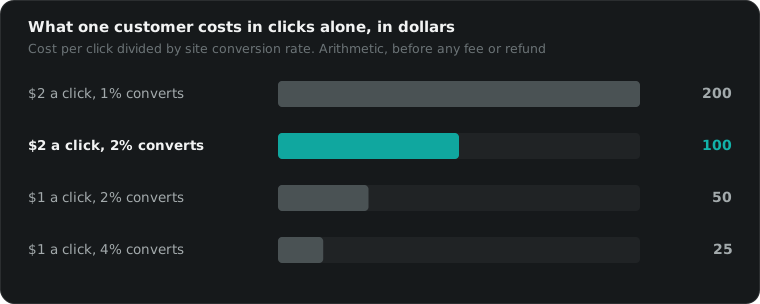
Compare it to gross margin per customer over a year. If a customer is worth $58 and costs $100 to buy, no amount of creative testing fixes that. The problem is the offer, the price, or the repeat rate. Spending on ads first just pays to discover it more slowly.
The second failure mode is capacity. A plumber booked six weeks out does not have a demand problem. Market him harder and you produce more calls he cannot service and a worse reputation with it. His next dollar goes to a second van, or to raising his prices, which is the fastest margin improvement available to any service business and the one nobody wants to hear.
Which businesses should spend on offline marketing instead?
Two kinds of business should spend offline instead: the ones whose entire market fits in a spreadsheet, and the ones already running at capacity. For both, the importance of digital marketing is low and falling, because more demand is not the constraint they actually have.
Here is roughly how I triage an enquiry before quoting.
| Business | Is digital the priority? | Where the next dollar is better spent |
|---|---|---|
| E-commerce shipping nationally, 20 plus products | Yes | Paid social and search, in that order |
| Self serve software with online signup | Yes | Search, then content that answers the search |
| Clinic or salon in one city | Partly | Search and reviews, not paid social |
| Restaurant with a three kilometre catchment | Partly | Maps listing, photos and reviews. Almost nothing paid |
| Trade business booked six weeks out | No | Prices, staff, capacity |
| B2B with under 200 possible buyers nationally | No | A named list, a phone, and flights |
| Wholesaler with eight major accounts | No | Account management and terms |
People argue with the last three rows.
In all three, the total addressable audience is small enough that you could contact every single one of them by hand for less than a quarter of what the ad spend would cost. Buying impressions to reach 200 people is theatre.
What digital does that nothing else can
Three things, and this is where the importance of digital marketing is genuinely high. It captures demand at the moment of decision, which is search. It creates demand that did not exist this morning, which is social and video. And it measures well enough to stop a losing test inside a fortnight.
Nothing offline does any of the three.
Social and video are the only real growth lever once search is maxed out, because search can only harvest demand that already exists. Measurement is imperfect and still useful, which is a sentence most agencies will not say out loud.
The third one is where most of the value sits. It is also the first thing brands give up when they hire badly, because an agency that reports on reach and impressions has quietly taken away the only advantage the channel had.
How do you decide in one afternoon?
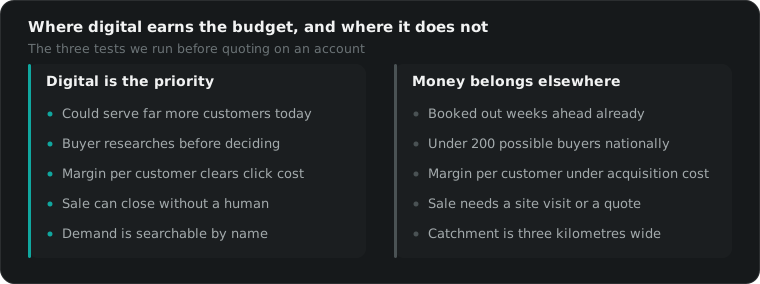
Answer three questions and the importance of digital marketing to your specific business stops being a matter of opinion. Can you serve more customers than you do now, does your buyer research before buying, and is your margin comfortably above what a customer costs in clicks?
- Could you serve significantly more customers next month than you have? If no, fix capacity or price first.
- Does your buyer research before they buy, somewhere you could show up? If no, you are buying interruption, which is a much slower and more expensive game.
- Is gross margin per customer over a year comfortably above what a customer costs in clicks? Run the division. If it is close, digital is a project, not a channel.
Three yeses and the importance of digital marketing to your business is high. Two is worth a small test. One is worth fixing the other two first.
What I tell people
I turn work away on this basis, which is not a boast. It is simply cheaper than taking an account I already know I cannot make work, and it saves an argument in month three about why the digital marketing is not producing what somebody hoped it would.
Under about $5,000 a month of ad spend there is not enough data for anyone to optimise against, and a fee on top makes the arithmetic worse rather than better. I would rather say that on a call than three months into an engagement.
If the answers point the other way, the mechanics matter more than the philosophy. I have written up how to write a digital marketing plan, which is where the arithmetic above turns into a budget, and media buying, which is the daily work that decides whether the plan holds.
My pricing is published in full, so you can put a real number into that division before you speak to anyone. If you want a blunt answer on whether digital is genuinely high leverage for your specific business, 15 minutes is usually enough.
Sometimes the answer is no, and the importance of digital marketing to your business turns out to be lower than everyone assumed. I say so.
Questions people actually ask
Why is digital marketing important?
Because it is the only marketing that tells you quickly whether your offer works. A billboard cannot report that nobody will pay 80 dollars for your product. Two weeks and a thousand dollars on search will. Beyond that, digital is important where demand can be searched for and the sale can close without a human.
Is digital marketing important for every business?
No. A trade business booked six weeks out, a B2B firm with fewer than 200 possible buyers in the country, or a wholesaler with eight accounts will all get a worse return from paid ads than from pricing, staffing or a phone. Digital rewards businesses that can serve more demand than they currently get.
How much of retail is actually online?
In the United States, e-commerce was 16.9 percent of total retail sales in the first quarter of 2026, on 326.7 billion dollars of online sales against 1,929.0 billion overall, according to the Census Bureau. So roughly five sixths of retail money still moves offline, even in one of the most digital markets in the world.
What does a customer actually cost from paid ads?
Divide the cost per click by the site conversion rate. At two dollars a click and a two percent conversion rate, one customer costs 100 dollars in clicks alone, before agency fees, returns or refunds. If your gross margin per customer is under that number, paid digital is not the problem to solve first.
What should a small local business do instead?
Fill in the Google Business Profile properly, get reviews, and make sure the phone gets answered. For a business with a three kilometre catchment, that combination beats paid social almost every time and costs nothing. Add paid search only when the calendar has gaps you want filled on specific days.
When does digital marketing become the priority?
When you can serve more customers than you currently reach, the buyer researches before purchase, and gross margin per customer comfortably exceeds acquisition cost. Hit all three and digital compounds. Miss one and the money is better spent fixing whichever one you missed.