4 Google Analytics Alternatives I'd Actually Use
 My short answer
My 4: Matomo if you want to own your data, Piwik PRO if it has to talk to Google Ads, Plausible for simple traffic with no cookie banner, and PostHog for what people do inside your product. Each of these Google Analytics alternatives fixes a different GA4 problem, so pick by the problem you've got.
Nobody loves GA4, which is why so many people go looking for Google Analytics alternatives. I get it.
I’ve moved 3 clients off it, and I moved 1 of them back. Here’s what nobody tells you before you switch: the thing you don’t like about GA4 is rarely the thing costing you money.
The pattern’s the same every time. The dashboards get cleaner, the numbers get calmer, and then someone asks why Google Ads is bidding worse than it was in March.
So before you pick from the Google Analytics alternatives below, work out which problem you’ve actually got.
Why everyone wants out of GA4
People go looking for Google Analytics alternatives for 4 reasons. Only 2 of them need a new tool. The other 2 you either fix inside GA4 or live with, because no vendor can fix them for you. Here’s the short list:
- Retention: a standard property only keeps event data for 14 months. A new tool fixes this.
- Thresholding and sampling: reports hide or estimate rows. You fix this inside GA4, with the BigQuery export.
- The event model: GA4 broke the old Universal Analytics numbers. No tool gives those back.
- Legal: the legal team isn’t comfortable with where the data goes. A new tool fixes this.
Retention is the concrete one. Google’s own data retention page puts the standard property maximum at 14 months for user level and event data. Analytics 360 goes to 50 months. Google signals data is capped at 26 months, whatever you choose.
So year on year analysis on a free property isn’t something you forgot to configure. It isn’t offered.
Thresholding is the annoying one. Turn on Google signals, look at a small segment, and rows disappear behind a warning icon. The data’s there. Google just won’t show it to you.
Then there’s the move itself. Universal Analytics stopped processing hits on 1 July 2023, and a lot of teams never made peace with the replacement. Sessions behave differently. Bounce rate came back as its own opposite.
That’s a real cost. A new vendor won’t refund it.
The 4 Google Analytics alternatives I’d actually use
Want to own your data? Matomo. Need conversions and cost flowing between your analytics and Google Ads? Piwik PRO. Just want simple traffic numbers with no cookie banner? Plausible. Want to see what people do inside your product? PostHog. None of them is better than Google Analytics at everything. Each one fixes a different GA4 problem.
Matomo: own your data
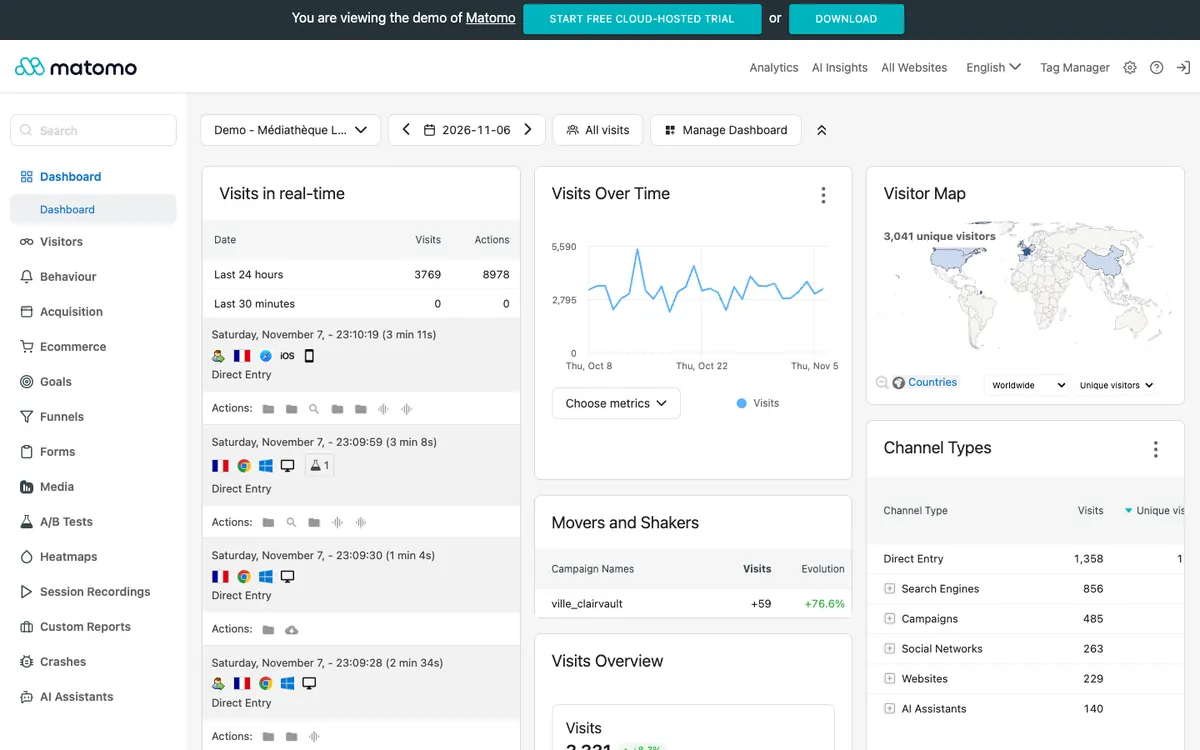
Matomo’s public demo, captured 7 Nov 2026.
Of all the Google Analytics alternatives, Matomo is the closest like for like GA4 replacement you can fully own. Ecommerce, goals, segments, funnels and raw data, and you can run it on your own servers with unlimited hits.
- Costs: Self hosted is free. Premium features are paid plugins, for example Funnels from €193 a year. Matomo Cloud is a paid plan with a free trial.
- Hosting: Your own servers, or Matomo Cloud, which stores the data in Frankfurt, Germany.
- Google Ads: Advertising Conversion Export sends conversions that carry a gclid to Google Ads on a schedule (a plugin from €169 a year if you self host). Cost import isn’t documented.
- Skip it if: you want cookieless out of the box. Cookies are on by default, and cookieless tracking is a setting you switch on.
Piwik PRO: the one that plays nicest with Google Ads
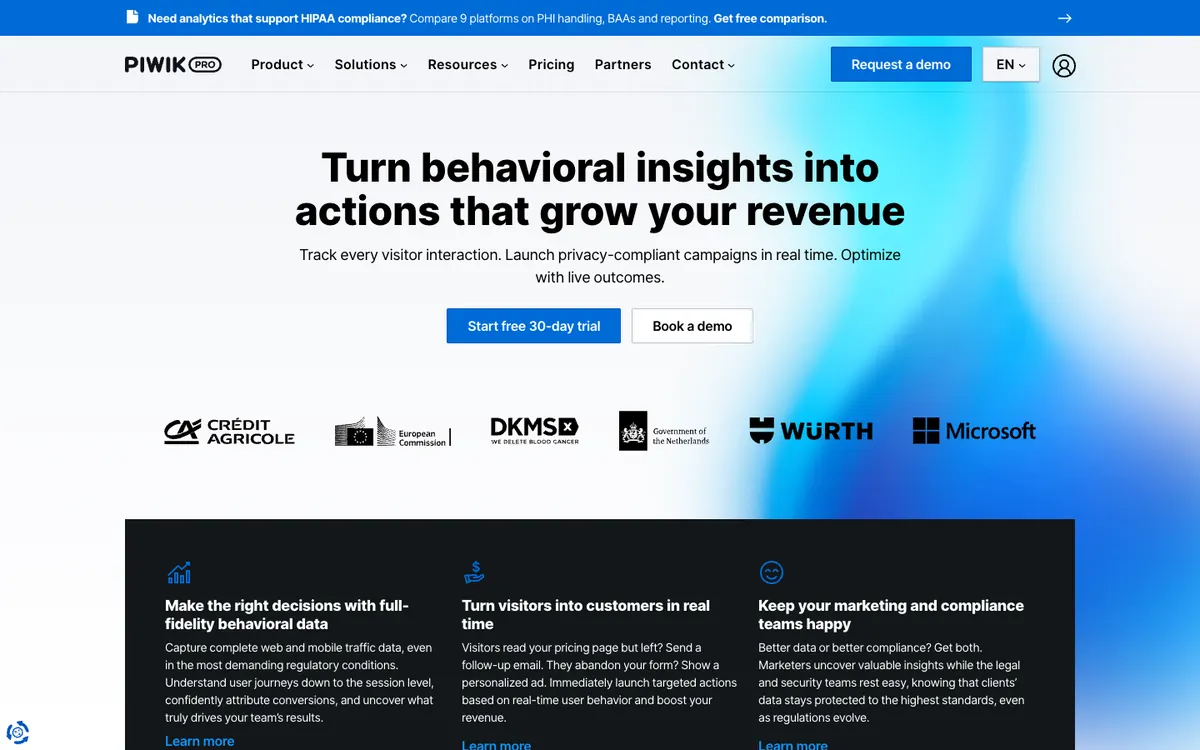
Piwik PRO’s homepage, captured 7 Nov 2026. There’s no public demo.
Piwik PRO is built for regulated sectors like healthcare, finance and the public sector, with analytics, a tag manager and a consent manager in one suite. For a media buyer, the draw is that conversions go out to Google Ads and cost comes back in.
- Costs: No free plan since the free Core plan ended in February 2026. Business starts at €36 a month for up to 2 million monthly actions, after a 30 day free trial.
- Hosting: Cloud only, no self hosting. Business is hosted in Sweden, and Enterprise can pick Germany, the Netherlands, Sweden, the US or Hong Kong.
- Google Ads: Data Activation uploads click conversions with a gclid to Google Ads automatically, and the Google Ads integration imports campaign and cost data. In the EU, uploads only cover visitors who gave consent.
- Skip it if: you need to self host, or you run more than 1 Google Ads account, which is the Business plan limit.
Plausible: simple traffic, no cookie banner
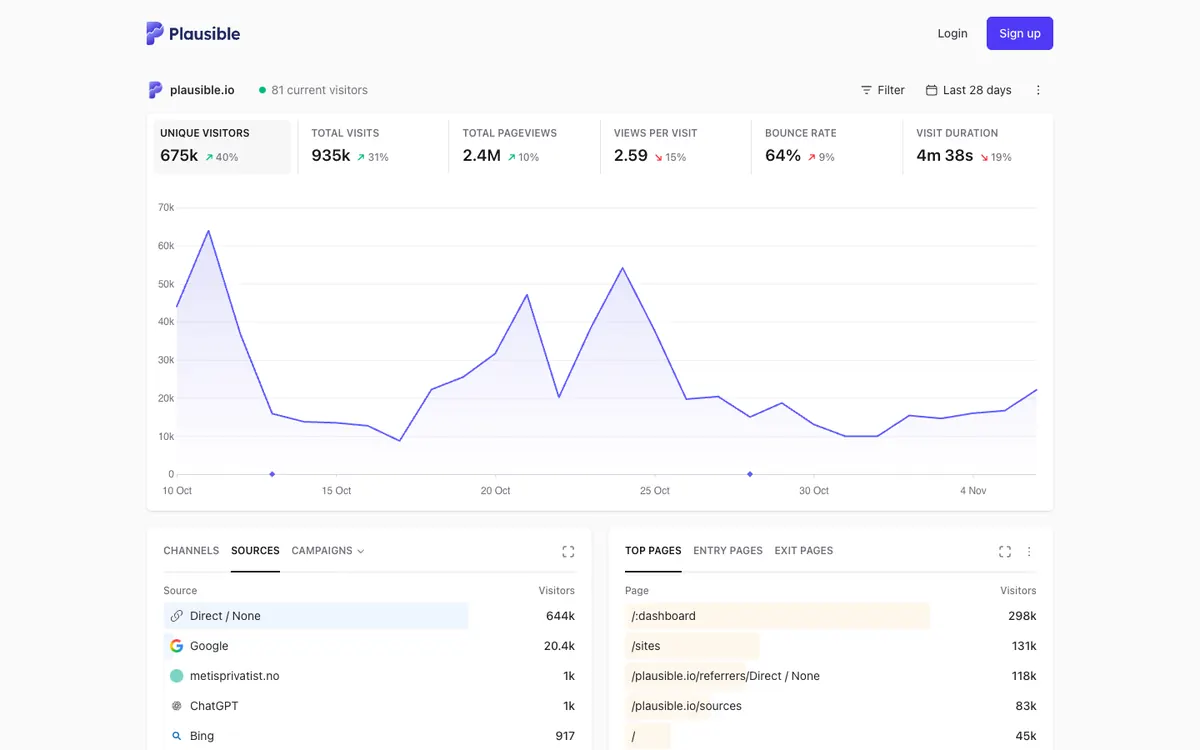
Plausible’s public live demo, which shows its own site’s traffic, captured 7 Nov 2026.
Plausible is clean traffic and campaign reporting on one dashboard, with a script it says is 54 times smaller than Google Analytics. It uses no cookies, and Plausible says no consent banner is required.
- Costs: From $9 a month for 1 site and up to 10k monthly pageviews, after a 30 day free trial. The self hosted Community Edition is free, without funnels or ecommerce revenue goals.
- Hosting: Plausible Cloud keeps visitor data in Falkenstein, Germany, with no region choice, or you self host the Community Edition.
- Google Ads: It reads gclid and UTM tags, so Google Ads traffic shows up as Paid Search and by campaign. It can’t send conversions back, so it can’t feed Smart Bidding.
- Skip it if: you need user level paths or attribution back to the ad click. It keeps aggregate data only.
PostHog: what people do inside your product
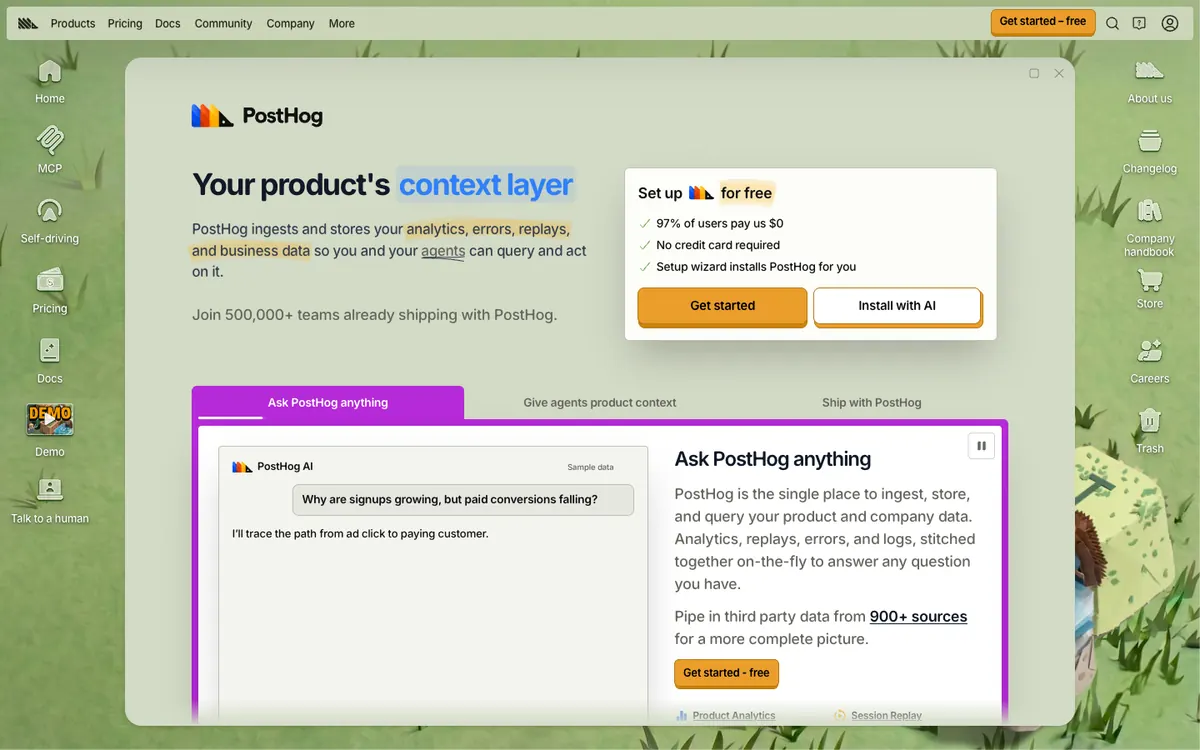
PostHog’s homepage, captured 7 Nov 2026. Its demo is a video.
PostHog is product analytics for software and SaaS teams: funnels, retention, session replay, feature flags and experiments in one tool. The free tier is generous, and it isn’t a trial.
- Costs: Free up to 1 million events, 5,000 session recordings and 1 million feature flag requests a month. After that it’s per event, from $0.00005 and cheaper with volume.
- Hosting: PostHog Cloud in the US (Virginia) or the EU (Frankfurt), your pick. Self hosting is free under an MIT license, but unsupported.
- Google Ads: A Google Ads destination sends conversions with a gclid, but PostHog labels it experimental and unsupported. Cost comes in through the data warehouse, and the marketing analytics view is an opt-in beta.
- Skip it if: you don’t have a developer. It’s built for product and engineering teams, and cookies are on by default unless you switch on cookieless mode.
Those 4 aren’t the only GA4 alternatives or Google Analytics competitors. Here are a few more tools like Google Analytics, each good at one thing:
- Fathom: simple cookieless traffic reports for site owners and agencies.
- Umami: an open source cookieless option you can self host.
- Mixpanel: product analytics for app teams.
- Amplitude: built for product and growth teams in larger companies.
- Adobe Analytics: the enterprise option, usually inside Adobe Experience Cloud.
Google Analytics vs the alternatives, side by side
Here are the 4 Google Analytics alternatives next to each other. Matomo, Plausible and PostHog all let you self host for free, and Piwik PRO is cloud only. Matomo and Piwik PRO send conversions back to Google Ads, PostHog’s route is experimental, and Plausible doesn’t send any. The starting prices are the published entry points, before volume.
| Tool | Best for | Hosting | Starts at | Feeds Google Ads |
|---|---|---|---|---|
| Matomo | Owning your data | Self hosted or cloud | Free self hosted, plugins extra | Yes, gclid conversion export |
| Piwik PRO | Google Ads and regulated sectors | Cloud only | €36 a month (Business) | Yes, conversion upload and cost import |
| Plausible | Simple traffic, no banner | Cloud or self hosted | $9 a month for 10k pageviews | No |
| PostHog | Product behaviour | Cloud or self hosted | Free up to 1M events a month | Experimental |
You might not need Google Analytics alternatives at all. The BigQuery export from GA4 is included, gives you every event at row level, and takes sampling and thresholding out of anything you query yourself.
Leaving GA4 gains you
- Raw event data you own outright
- Hosting and residency you control
- No thresholding, no sampled reports
- Retention limited by storage, not policy
Leaving GA4 costs you
- Conversion import into Google Ads bidding
- Audience import and Search Console link
- Free YouTube and Google signals reporting
- A tool every analyst you hire knows
What you give up when you leave GA4 (the expensive part)
Every one of the Google Analytics alternatives above costs you the native Google integrations, and on a paid media account that’s where it gets expensive. Some can upload conversions, but here’s what you still lose, even with the best of them:
- GA4 key event bidding in Google Ads
- Audience import into Google Ads
- The Search Console link
- Free YouTube reporting
- The tool every analyst you hire already knows
That last one sounds soft. It isn’t.
Hire in Riyadh or Amman and GA4 is the only analytics product you can assume someone has touched. A Matomo instance with a custom schema means the person who built it is the only person who can maintain it. And they’ll leave.
The bidding loss is the one you can measure. Smart Bidding learns from the conversions it receives. Cut off the GA4 key event route and you need the Google Ads tag, enhanced conversions and ideally server side events doing the same job.
That’s fine. It’s what I set up anyway. But somebody has to do that work before you switch, not after.
And every benchmark conversation with a client, an investor or a platform rep assumes Google Analytics numbers. Turn up with different definitions of session and channel, and every meeting starts with 20 minutes of reconciliation.
Privacy friendly analytics, and hosting in the Gulf
Privacy friendly analytics is enough for a content site. For an ecommerce or lead generation account, it isn’t. These tools count visits without identifiers, and they’re good at it. That’s also what stops them attributing a purchase back to an ad click 3 days and 2 devices later. It’s the design, not a bug.
If you buy media, you still need that path. What replaces it isn’t a dashboard. It’s advertisement tracking done at the server:
- platform conversion APIs
- hashed customer data
- a click ID stored on your own domain
So run both. Lightweight analytics for the traffic picture, platform and server side data for the money.
Hosting is where the Gulf changes things. Data residency rules, including Saudi Arabia’s Personal Data Protection Law, push some clients toward hosting they control. Government adjacent work in Saudi Arabia and the UAE asks more and more where the data sits, and “a Google region somewhere” doesn’t survive procurement. A bank in the Gulf that can’t send visitor data to a US cloud has a real constraint, and self hosted analytics is a real answer to it.
The smaller problems are more irritating:
- Billing: paying by card in USD is fine from the UAE and Saudi Arabia, harder from Lebanon.
- Arabic support: thin in the smaller tools.
- Bot traffic: traffic from regional data centres inflates numbers in tools without decent filtering. GA4 is better at this than most people give it credit for.
What I’d do
I keep GA4 for reporting on almost every account, and I put the effort into the tracking underneath instead. One of the Google Analytics alternatives goes in when a client needs raw event data or their own hosting. It runs alongside GA4 rather than replacing it, for the first 3 months.
That overlap isn’t caution for its own sake. When 2 tools disagree by 8%, that’s normal and explainable. When they disagree by 40%, one of them is wrong, and you can only find out which while both are running.
If I do add one of these Google Analytics alternatives, it’s Matomo to own the data, Piwik PRO when it has to talk to Google Ads, Plausible for a content site and PostHog for a product.
If you’re spending under about $10,000 a month, Google Analytics alternatives aren’t your problem. Your purchase event probably fires twice on one browser and not at all on iOS Safari. Your key events were rebuilt badly after Google Analytics goals were retired.
No dashboard fixes either of those.
If your money runs through Google Ads, that’s usually a bad trade, unless it’s Piwik PRO. If it doesn’t, go for it.
Not sure it’s worth switching on your setup? Talk to me.
Questions people actually ask
What is the best alternative to Google Analytics?
There isn't one. Matomo wins on ownership, because you can host it yourself for free. Piwik PRO plays nicest with Google Ads, with conversion upload and cost import. Plausible wins on simple, cookieless traffic numbers. PostHog wins on product behaviour and funnels. Adobe Analytics wins at enterprise scale. Pick by the problem you've got, not by a feature table.
Is there a free Google Analytics alternative?
Yes, 3 of my 4. Matomo is free and open source if you host it yourself. Plausible's Community Edition is a free, open source Google Analytics alternative you self host, without funnels or revenue goals. PostHog is free up to 1 million events a month in its cloud, and free to self host. Piwik PRO no longer has a free plan.
Is Matomo a real replacement for GA4?
For reporting, yes. Matomo covers sessions, sources, goals, funnels and heatmaps, and you can host it yourself so the raw data never leaves your infrastructure. It can send gclid conversions to Google Ads through its Advertising Conversion Export, but cost import isn't documented, and you lose GA4 key events and audiences. So on a paid search account, it sits beside GA4 instead of replacing it.
How long does GA4 keep my data?
A standard GA4 property keeps user level and event data for either 2 or 14 months, and 14 is the most you can select. Analytics 360 properties can go up to 50 months. Google signals data is capped at 26 months, whatever the setting says. Aggregated reports aren't affected by any of these limits.
Do I lose Google Ads conversion tracking if I leave GA4?
You lose the GA4 route into it, not the tracking itself. Google Ads has its own conversion tag and its own enhanced conversions, and most accounts should be using those anyway. What you really lose is the GA4 audience import and the ability to bid on a GA4 key event. That matters more on lead generation than on ecommerce.
Is a cookieless analytics tool legal by default?
Usually easier, not automatically legal. Tools that store no identifier and no personal data often fall outside consent requirements, but that depends on your jurisdiction and your configuration. Even Matomo only says cookieless tracking may be exempt. Saudi Arabia, the UAE and the EU each have their own rules. Ask a lawyer about your setup. Don't rely on a vendor's compliance page.