

AI Marketing Tools That Work for Small Business (2026)
I have managed over $50M in ad spend across Meta, TikTok, Google, and Snapchat. I have worked with local businesses running $500/month budgets and global brands burning through six figures a week. The single biggest difference between the ones that grow and the ones that spin their wheels is not budget. It is whether they have a system.
AI marketing tools in 2026 are everywhere. Every platform has an AI feature. Every SaaS product has an AI layer. HubSpot’s State of Marketing report found that 64% of marketers are already using AI in some capacity — yet most still report inconsistent results. And most small business owners I talk to are either overwhelmed by the options or quietly disappointed that ChatGPT did not magically transform their marketing.
This is the honest guide. Not a roundup of every tool with an affiliate link. Just what actually works, what to skip, and how to stop wasting time on AI that sounds good in a demo but does nothing in the real world.
Table of Contents
Why Most AI Marketing Tools Fail Small Businesses
Most AI marketing tools are built for marketers with time, a team, and a brief. You open the tool, you paste in some context, you tweak the output, you hand it off to a designer. That workflow works if you have those resources.
Small business owners do not have those resources. They are writing the copy, scheduling the posts, running the ads, and responding to customer messages, all in the same afternoon. They need AI that works with zero setup time and produces something usable in one pass.
That is the gap. Most AI tools give you a blank box and say “go.” What you actually need is a structured starting point. The right prompts, built for your specific situation, already loaded with context so the output is relevant and usable without a 20-minute editing session.
With that framing, here is what is worth using.
Best AI Tools for Content Creation
ChatGPT
Still the most capable general-purpose writing tool available. For social captions, blog outlines, product descriptions, and short-form copy, it is hard to beat. The output quality is directly proportional to the quality of your prompt.
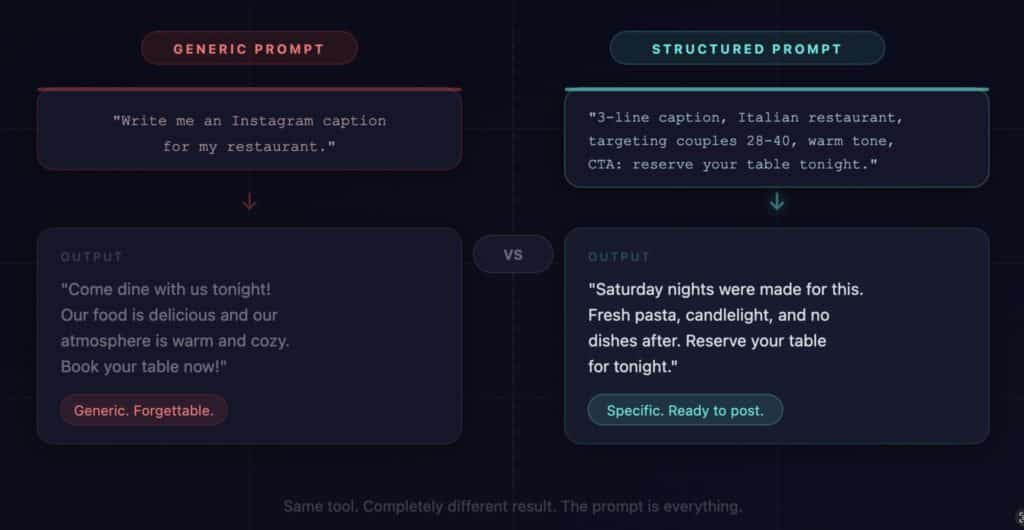
The mistake most people make is prompting it like a search engine. “Write me an Instagram caption for my restaurant.” You will get a caption. It will be forgettable. Instead, give it your brand voice, your specific audience, the post format, and the goal. The difference between a lazy prompt and a structured one is the difference between content that looks AI-generated and content that sounds like you.
Best for: Social content, email copy, blog drafts. Free tier available; $20/month for Plus.
Canva AI
Canva’s Magic Write and Magic Design features are genuinely useful for small businesses that need to produce visual content quickly. It generates social graphics, presentation decks, and short video clips from text prompts. Not a replacement for a real designer, but more than good enough for organic social and quick ad creative.
Best for: Social graphics, templates, short video. Free tier available; $15/month for Pro.
Best AI Tools for Paid Media
Meta Advantage+
Meta’s AI layer is built directly into Ads Manager. Advantage+ automatically generates and tests multiple creative variations, targets the right audience based on conversion data, and optimizes delivery. For small businesses already running Meta ads, this is not optional anymore. It is the default.
The catch: it works best when you feed it quality creative inputs. Strong copy and clear visuals give the algorithm something to work with. Weak inputs just mean the AI is optimizing garbage at scale.
Best for: Scaling Meta campaigns. Included in Meta Ads Manager at no extra cost.
Google Performance Max
Google’s fully automated campaign type runs across Search, Display, YouTube, Gmail, and Shopping from a single campaign. You provide creative assets, the AI handles placement and bidding. For small businesses that want Google coverage without managing five separate campaign types, this is the practical choice.
Best for: Multi-channel Google advertising. Works best with some conversion history for the algorithm to learn from.
Best AI Tools for Email Marketing
Klaviyo AI
If you are running an e-commerce brand, Klaviyo’s AI features are the most useful on the market. Predictive analytics, send-time optimization, subject line suggestions, and segment recommendations are all built in. The AI learns from your audience’s behavior, not generic benchmarks.
Mailchimp AI
For service businesses and general newsletters, Mailchimp’s AI content generator is easier to onboard and more flexible. It handles welcome sequences, promotional emails, and re-engagement campaigns. The drafts are not perfect, but they are a solid starting point. Both have free tiers to get started.
The Case for an End-to-End AI Marketing System
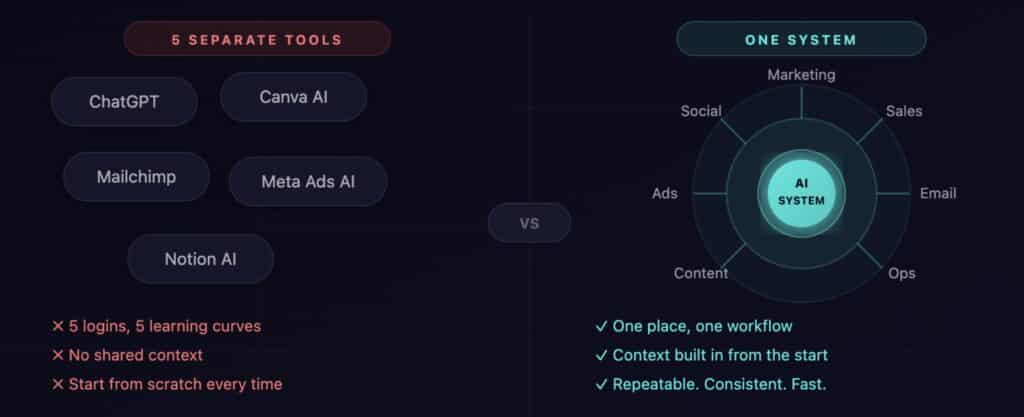
Here is the problem with the tool-by-tool approach: you end up with five different tools, five different logins, five different learning curves, and still no system. You are still starting from scratch every time you need to write an email, plan a campaign, or respond to a client brief.
What actually moves the needle for small businesses is having one structured system that covers marketing, sales, and operations together. Not a chatbot you improvise with. A real workflow with purpose-built prompts for every task, ready to run.
That is what Quipt’s Small Business AI System is built for. It covers social content, ad copy, email sequences, client outreach, sales follow-ups, and operational SOPs, with structured prompts and before/after examples for each workflow. No blank-page problem. No 20-minute editing pass to make the output sound human.
I recommend it specifically because it is the closest thing I have seen to a complete AI marketing operating system for a small business, as opposed to a single-task tool you still have to figure out how to use.
What to Avoid
Paying for 10 tools instead of mastering 2
Tool hopping is the most expensive habit in small business marketing. Every new tool has a learning curve. Every subscription adds up. Pick two or three, learn them properly, build your workflows around them, and stop chasing the next thing.
Treating AI as a shortcut instead of a multiplier
AI does not replace good thinking. It multiplies it. If your strategy is wrong, AI will execute your bad strategy faster. If your creative is weak, AI will scale your weak creative to a bigger audience. AI works best when you give it clear direction and strong inputs.
Publishing unedited output
AI-generated content is a first draft, not a finished product. Read it. Edit it. Make sure it sounds like you. The goal is not to eliminate the human from the process. It is to eliminate the blank page and the time sink.
Using vague prompts
“Write me a social post” produces a social post. “Write me a 3-line Instagram caption for a local gym targeting working parents who want 30-minute workouts, in a tone that is motivating without being aggressive, with a soft CTA to book a free class” produces something you can actually post. The quality of the output is almost entirely determined by the quality of the input.
Frequently Asked Questions
What are the best AI marketing tools for small businesses?
The most useful AI marketing tools for small businesses in 2026 are ChatGPT (with structured prompts), Meta Advantage+, Canva AI, and Quipt’s Small Business AI System for end-to-end marketing, sales, and operations workflows.
Is AI actually useful for small business marketing?
Yes, but only if you use it with structure. Generic AI output looks generic. The difference is having a system with proper prompts built for your specific tasks, not just asking ChatGPT open-ended questions.
What is the difference between AI tools and an AI system for marketing?
A tool does one thing. A system covers a full workflow with structure, context, and repeatable steps. For marketing, a system means having the right prompts for every task, including social content, ad copy, emails, and client outreach, not just a chatbot you improvise with.
Can I use AI to replace a marketing agency?
For most small businesses, yes on the execution side. AI can handle content creation, email copy, ad drafts, and social posts at a fraction of agency cost. Strategy and media buying still benefit from human judgment, but the production work is very handleable with the right tools.
How do I avoid generic AI output in my marketing?
Give AI more context. Include your brand voice, target audience, platform, goal, and tone in every prompt. Better yet, use a purpose-built system that has all that context built in from the start.