Facebook Ads for Small Business: Budget, Setup, Mistakes
 My short answer
Facebook ads for small business work when you build them in this order: Pixel and Conversions API, one conversion event, one broad campaign, then new creative every month. Budget for at least 30 to 50 results a month, which is $600 to $1,000 if a sale costs you $20. Most failures skip that order.
Nobody starts a business to learn Ads Manager, which is why Facebook ads for small business go wrong in such predictable ways. I get it.
Most accounts I open tell the same story. A few boosted posts, 4 ad sets fighting over $20 a day, a Pixel nobody’s checked since it went in, and an owner who’s decided Facebook doesn’t work.
It usually does. It just needs doing in the right order.
Here’s the order I use, what I’d spend, and what to avoid.
Facebook marketing for small business is a paid channel now
Facebook marketing for small business used to mean posting to a page and waiting. That stopped working years ago. On the accounts I run, an unpaid page post reaches roughly 2 to 5 percent of followers, and most of them already bought. Facebook ranks the feed by predicted engagement, and a promotional post rarely wins.
There’s more content than feed, so ranking is the only option. Your post also competes with recommended video from accounts people don’t follow.
The money tells the same story. Meta’s third quarter 2026 results report ad impressions up 10% year over year and average price per ad up 14%. Impressions are being sold, not given away, and they’re getting more expensive.
That’s the shift with Facebook for small businesses: the ads are the part that grows anything. So using Facebook for small business marketing now comes down to 2 questions:
- What will you pay for attention? That’s the budget.
- What do you do with it when it arrives? That’s the page, the creative and the follow up.
What your Facebook page is still for
Your Facebook page isn’t a distribution channel any more. It’s where a paid click lands, the proof a buyer checks before spending money, and the inbox where the awkward questions arrive. Treat it like a shopfront that has to look open, not a publishing schedule you owe a post every single day.
It does 3 jobs:
- Credibility: someone sees your ad, taps the page name, and spends about 9 seconds deciding whether you’re a real business. A page with no posts since 2023 answers that badly.
- Identity: the page name and profile photo sit on top of every ad you run.
- The inbox: Messenger and comment replies close more sales in Gulf markets than anyone plans for.
Posting 2 or 3 times a week covers all 3. Posting daily to chase reach that isn’t there is unpaid work.
That goes double for Facebook marketing for local business, like a clinic, a salon or a restaurant. People check the page before they call. The cheapest way to promote your business on Facebook is still a page that looks open.
The page: proof and follow up
- Reaches 2 to 5 percent of followers
- Answers the 9 second credibility check
- Puts its name and photo on every ad
- Handles Messenger and price questions
The budget: reach and learning
- Buys impressions from people with no history
- Feeds the auction the conversion signal
- Tests 6 to 10 new ads a month
- Sets the real cost per customer
What to spend on Facebook ads for small business
A budget for Facebook ads for small business starts from what a result costs you. I want at least 30 to 50 results a month before I trust a number, so a $20 sale means $600 to $1,000 of spend. Meta’s guide wants about 50 results per ad set in 7 days. Small budgets rarely reach that.
| Cost per result | My floor: 30 to 50 results a month | Meta’s learning target: 50 results in 7 days |
|---|---|---|
| $10 | $300 to $500 a month | $500 a week |
| $20 | $600 to $1,000 a month | $1,000 a week |
| $60 | $1,800 to $3,000 a month | $3,000 a week |
The right column comes from Meta’s guide to launching a campaign, which asks for a minimum of 50 events over 7 days, per ad set. Few small businesses hit that on purchases, so the setup has to make up for it.
What that means on a small budget:
- 1 campaign, 1 ad set if you can. That’s the structure I’d use for most Facebook ads for small business. Split $1,000 across 4 ad sets and none of them ever learns.
- Optimise for an event you can hit. If 50 purchases a week is out of reach, a lead or an add to cart happens more often. Move to purchase when the volume’s there.
- Run it for at least 7 days. Meta’s pricing page says to set a budget that lasts at least 7 days so it can learn.
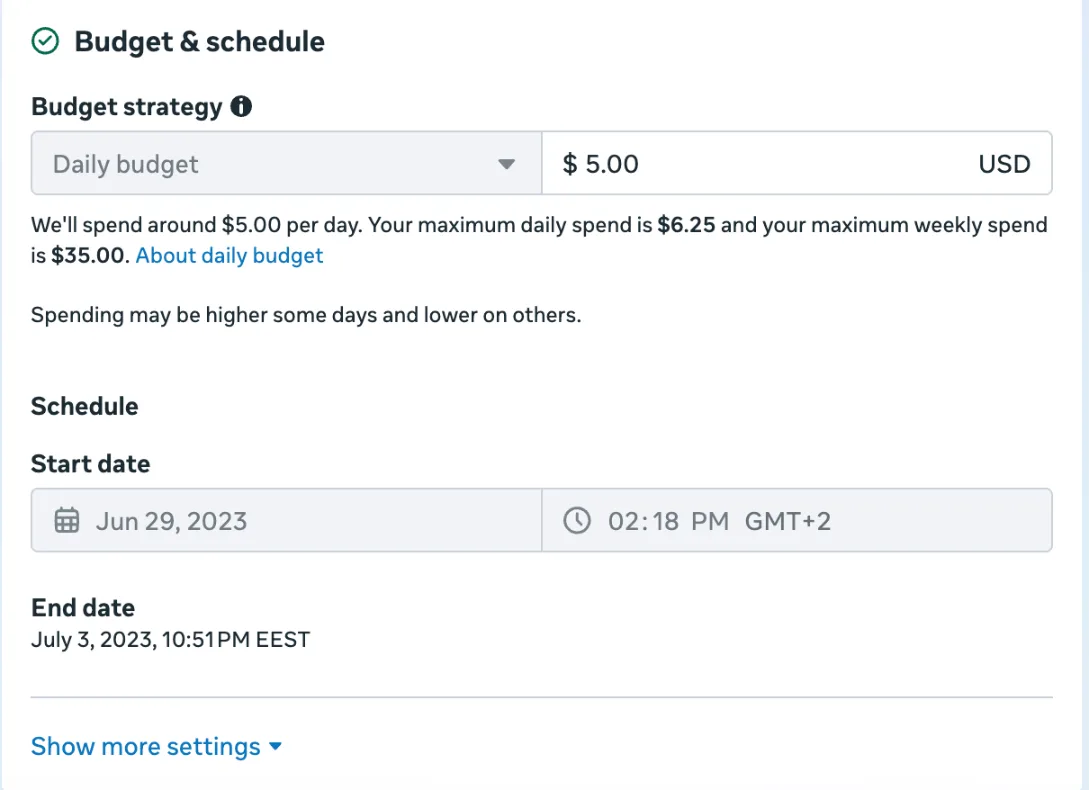
- Expect uneven days. Ads Manager shows it plainly: a $5 daily budget can spend up to $6.25 on one day, but never more than 7 times the daily budget across the week.
How to advertise your business on Facebook, step by step
Here’s how to run Facebook ads for small businesses in the order I set them up. Tracking first, then one conversion event, one broad campaign, more creative than feels reasonable, results read at the ad level, and a written rule for what gets switched off. Most accounts I audit built the campaign and skipped everything around it.
- Fix tracking first. Pixel plus the Conversions API, with deduplication, and a test purchase you watch arrive in Events Manager. The Conversions API sends events from your server, so you’re not relying on the browser alone.
- Pick one conversion event. Purchase, or qualified lead. Not both. An ad set optimising for 2 things optimises for neither.
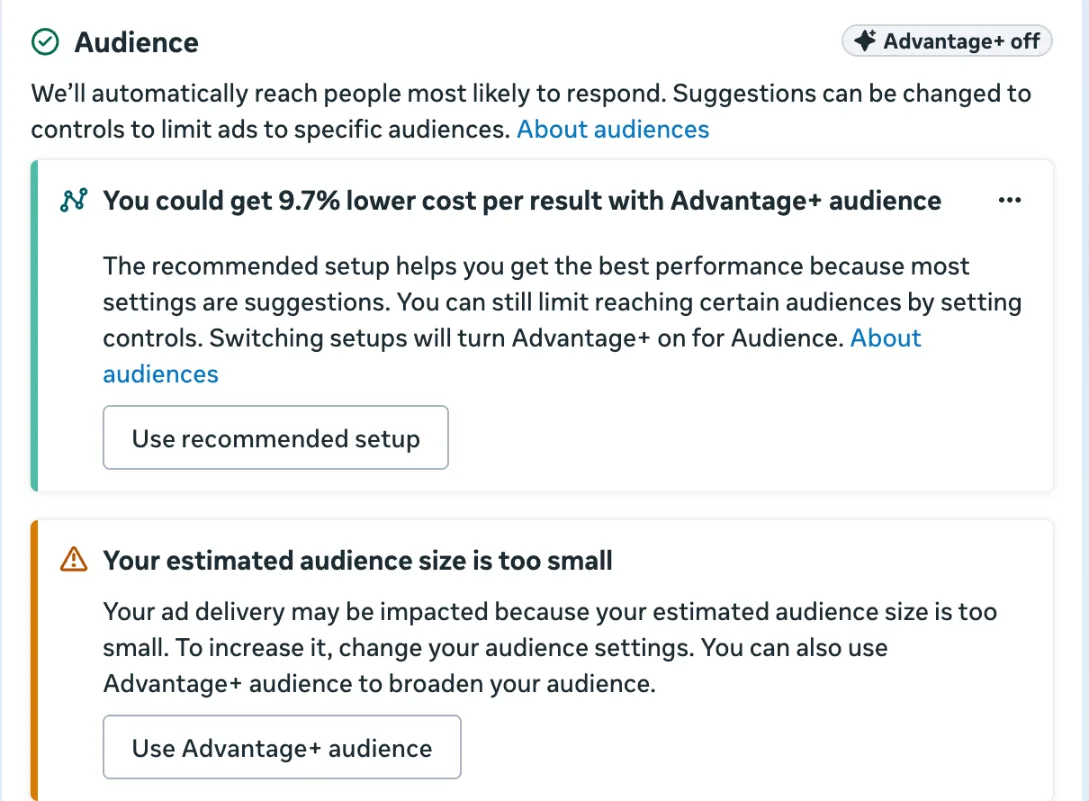
- Build one campaign. In Ads Manager that’s an Advantage+ sales campaign for a shop, or an Advantage+ leads campaign for a service. Meta counts a campaign as Advantage+ when Advantage+ campaign budget, Advantage+ audience and Advantage+ placements are all on.
- Go broad. Location, age if it really matters, and exclusions for existing customers. Meta’s pricing page says ad sets with an audience of at least 2 million often perform better. My piece on Facebook audience targeting covers what’s still worth setting.
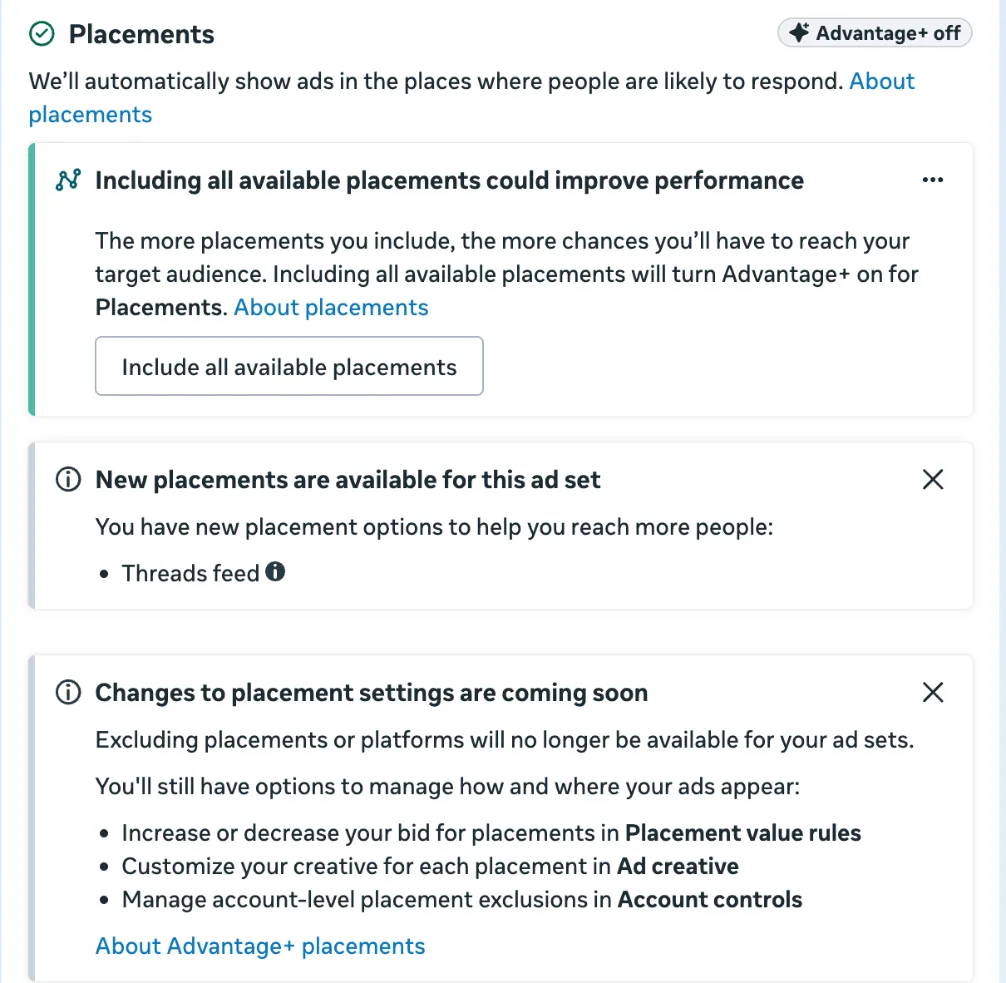
- Leave placements on Advantage+. Meta’s advice is Advantage+ placements, or at least 6 placements if you pick them by hand. Meta ad placements has what’s changing there.
- Ship creative in volume. 6 to 10 new ads a month, in different formats, saying genuinely different things. This is the job now.
- Read results at the ad level, and kill on a rule. Cost per result by creative, not by audience. Write down the cost at which an ad comes off. Then do it.
Most Facebook ads for small business fail at step 1. If your events are wrong, the auction learns from the wrong people and no targeting rescues it. My advertisement tracking piece goes through the server side part.
Step 6 is where almost everyone stalls, because it’s the only one that needs a camera and a person willing to be on it. If you’re choosing between a better targeting setup and one more week of shooting, shoot.
That’s most of how to run successful Facebook ads. The setup is the easy part.
Where the money goes each month
With Facebook ads for small business, most of the budget goes into the auction, but most of the result comes out of the creative. On a typical month I’d expect 80 to 85% of the cash in media and the rest in production. Targeting is now the smallest lever, and it’s still the one people argue about most.
Here’s the split I plan against. It’s illustrative, because margin moves it:
- Media in the auction, 80 to 85%: impressions, and the data the auction learns from.
- Creative production, 10 to 15%: new hooks, new angles, enough volume to test.
- Tracking and setup: a one off, then small.
- Audience research: almost nothing. Broad plus a few exclusions beats a hundred interests.
Advantage+ and broad targeting ate the part of the job that used to feel clever. So small business Facebook advertising is won on usable ads per month, not on better spreadsheets.
What a lead costs on Facebook in MENA
Cost varies more by category than by country. As an illustrative range from accounts I run, a simple lead form in the Gulf lands somewhere between $2 and $12, a qualified booked call costs several times that, and an ecommerce purchase depends almost entirely on price point. One number for the whole region is a guess.
3 things move it more than the market does:
- The offer: a form asking for a name and a phone number is cheap and mostly noise. A form with 3 qualifying questions costs more per lead and less per customer.
- The creative: the gap between the best and worst ad in the same account is routinely 3 or 4 times on cost per result.
- The follow up: in Saudi and the UAE, a lead called back within 5 minutes converts at a completely different rate than one called the next day.
That last one isn’t a media buying problem, and no ad account can fix it. It’s also why I never quote one cost for Facebook ads for small business across the region.
The mistakes I see most
These are the Facebook marketing tips for small business owners I give most, written as the mistakes they fix. Every one shows up in the small business Facebook ads I audit, usually 3 or 4 at once, and each one quietly teaches the auction the wrong thing.
- Boosting posts and calling it advertising. Boost buys reach and engagement on a post that already exists. It doesn’t buy a purchase.
- Too many ad sets. 4 ad sets on $20 a day is the most common setup I see in Facebook ads for small business. None of them gets near 50 results a week.
- Editing every few days. Big edits can send an ad set back into learning. Change things once a week, not every time a number moves.
- Stacking interests. Meta’s own guide warns that a too narrow audience can raise costs. Broad plus exclusions does the job.
- Tracking with no deduplication. Pixel and Conversions API both firing without it can count one sale twice, and the auction learns from the wrong number.
- Slow follow up. A lead that waits a day is a different lead.
The comment section closes the sale
The comment section under a Facebook ad is read by people who are close to buying, and it’s the part of small business Facebook marketing that gets ignored most. Unanswered questions, an old complaint or spam sitting at the top of an ad with real spend behind it will cost you more sales than any bidding mistake.
Comments carry across every ad using the same post ID, which is why I run the best creative as one post across every ad set. Social proof adds up. So do the arguments.
2 rules:
- Answer every price question with the price. Asking people to DM reads as expensive and evasive, and in Gulf markets it reads as a bad sign.
- Hide abuse, don’t delete it. Deleting starts a fight. Meta’s help page on hiding comments says a hidden comment stays visible to the person who wrote it and their friends, and disappears for everyone else.
This is also where micro-influencers earn their fee, because a creator’s own audience will defend a claim in a way your brand account never can.
What I’d do
I run Facebook ads for small business as a paid channel with a page attached, not the other way round. That means one conversion event, tracking rebuilt properly on day one, one broad campaign, and enough new creative each month that the auction has something to choose between each week.
That’s the whole Facebook marketing strategy for small business budgets I’d write. If you’re marketing a small business on Facebook for the first time, start at step 1 and don’t move on until a test purchase shows up in Events Manager.
Under about $2,000 a month, Facebook ads for small business don’t produce enough conversion data for anyone to optimise against, and paying a fee on top makes your maths worse. Run them yourself, in the order above, and get help when the spend outgrows your time.
Not sure where your account’s going wrong? Talk to me.
Questions people actually ask
Is Facebook advertising for small businesses still worth it?
Yes, as a paid channel with a real budget behind it. An unpaid page post reaches roughly 2 to 5 percent of followers on the accounts I run, so posting alone won't grow much. Ads reach people who've never heard of you, at a cost per result you can measure. Under about $2,000 a month, run them yourself rather than paying someone to.
How much should a small business spend on Facebook ads?
Work backwards from your cost per result. I want at least 30 to 50 results a month, so at $20 a purchase that's $600 to $1,000 of spend, and at $60 it's $1,800 to $3,000. Meta's own guide wants about 50 results per ad set in 7 days to finish learning, which is why fewer ad sets work better on a small budget.
Can I advertise my business on Facebook with a small budget?
Yes. Meta's pricing page suggests starting with at least $5 and running for more than 6 days, so the delivery system has time to find people. That's enough to check an ad runs, not to learn what sells. Below the 30 to 50 results a month I plan for, most of what you read in Ads Manager is noise.
How can I promote my business on Facebook for free?
Post on your page 2 or 3 times a week, answer every comment and message, and keep your hours, prices and photos current. Expect little reach: an unpaid post reaches roughly 2 to 5 percent of followers on the accounts I run. Free work keeps the page credible for when you pay for attention. It won't bring in strangers.
Do boosted posts work?
Boosting buys reach and engagement on a post that already exists. It doesn't buy a purchase, because the objective and the optimisation are wrong for that. It's fine for filling a comment section with real activity before a launch. It isn't a substitute for a campaign built in Ads Manager against a conversion event.
How long before Facebook ads start working?
Give a new ad set at least 7 days before you judge it. Meta's pricing page says to set a budget that runs for at least 7 days so it can learn, and its campaign guide says learning settles at about 50 results in 7 days. Big edits can restart that learning, so change things weekly, not daily.