Meta ad placements update: the off switch is going away

Meta ad placements are changing. Meta is removing placement exclusions from ad sets, so no more Instagram only ad sets or unticking Reels. Instead you can raise or lower your bid per placement, give each placement its own creative, and switch off 4 placements for the whole ad account.
Meta ad placements are about to work differently. Meta is removing placement exclusions from ad sets, and the notice appeared in our own Ads Manager on 14 October 2026. It is short: excluding placements or platforms will no longer be available for your ad sets. That means no more Instagram only ad sets, and no more unticking Reels.
If you run Meta ads for your own business, here is the short version of what happens to your Meta ad placements. You lose the off switch. You keep a dial.
What is changing with Meta ad placements?
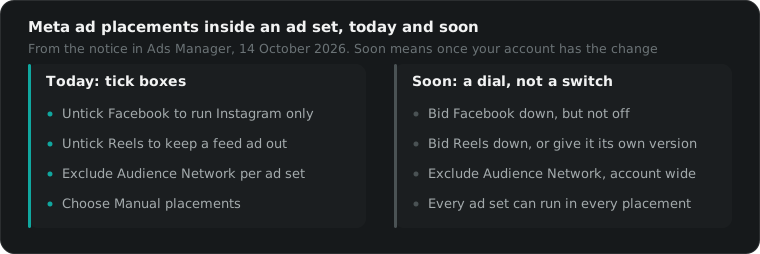
Meta is taking away the option to exclude placements or platforms inside an ad set. Today you can untick Facebook, Reels or Messenger and your ad never shows there. Once the change reaches your account, every ad set can run everywhere Meta offers, and you steer it by raising or lowering your bid per placement instead.
This is the notice, word for word, as it appears in Ads Manager:
Excluding placements or platforms will no longer be available for your ad sets. You’ll still have options to manage how and where your ads appear: Increase or decrease your bid for placements in Placement value rules. Customize your creative for each placement in Ad creative. Manage account-level placement exclusions in Account controls.
Two words worth pinning down. A placement is a spot where your ad can appear: the Instagram feed, Facebook Reels, Messenger, Facebook Marketplace. A platform is the app itself: Facebook, Instagram, Messenger, WhatsApp, Threads and Audience Network. The change covers both.
Does this only affect Advantage+ placements?
No. Manual control of Meta ad placements is the part that goes. Advantage+ placements is already the default and runs your ads everywhere. Switching to manual placements and unticking boxes is how you exclude, and Meta’s notice removes placement exclusions from ad sets with no exception for manual. So the manual route is what disappears.
This part confused us too, so it is worth being exact. Meta’s own help page on choosing placements still walks through manual placements step by step, and notes that excluding any placement switches Advantage+ off. That page describes how things work today. The notice describes what is coming, and the two will disagree until the rollout finishes.
Can you still run Instagram only ads?
Not with a tick box. You will not be able to switch Facebook off in an ad set, because that is a platform exclusion. You can lower your bid on Facebook placements so more of the budget goes to Instagram. Meta has not published how low that bid can go, so do not plan around Facebook getting nothing.
Reels works the same way. You cannot keep a feed ad out of Reels any more. You can bid Reels down, or give Reels its own vertical version so it shows something made for it.
What can you still control on Meta?
Three things still shape your Meta ad placements, all named in Meta’s notice. You can raise or lower your bid for each placement with placement value rules. You can give each placement its own creative. And you can switch off a short list of placements for your whole ad account in account controls.
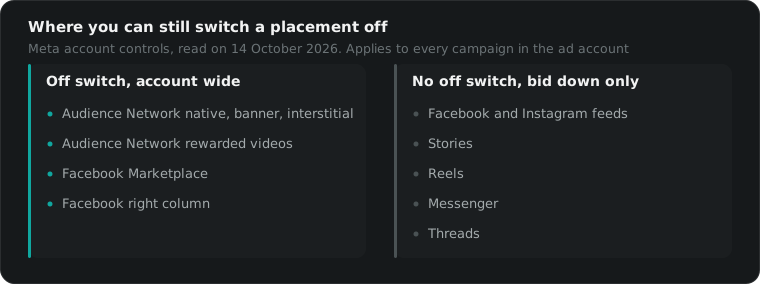
Account level is now the only place placement exclusions survive, and that list is shorter than most people expect. Meta’s help page on account controls, read on 14 October 2026, gives 4 placements you can exclude at account level:
- Audience Network native, banner and interstitial
- Audience Network rewarded videos
- Facebook Marketplace
- Facebook right column
Reels, Stories, the feeds, Messenger and Threads are not on it.
Two details matter. Account controls apply to every campaign in the account, existing ones included, and Meta says changes to existing campaigns can take up to 48 hours. And they do not apply to ads about social issues, elections or politics, or ads about financial products and services, employment or housing.
Here is where each kind of exclusion goes once the change lands.
| Why you excluded it | Where it goes now |
|---|---|
| Brand safety, such as Audience Network | Account controls, for the whole account |
| Marketplace or the right column felt wrong for the brand | Account controls, for the whole account |
| It cost too much or sent bad leads | Placement value rules, bid it down |
| The ad looked wrong in that spot | Ad creative, give that spot its own version |
Was excluding a placement ever really off?
Not always. Meta’s placements page has an option called Allow limited spend to excluded placements. With it on, Meta can spend up to 5% of your budget on each placement you excluded, when it expects that to improve performance. So in some accounts, placement exclusions already meant mostly off rather than off.
That does not make this change small. It shows where Meta has been heading for a while: you describe the outcome, and the system decides where to buy it. If you want the wider picture of how that buying works, our guide to media buying covers it.
Is this good or bad for businesses?
On paper, it is fine. Meta says that in an experiment, ad sets using Advantage+ placements delivered an 11.7% lower cost per action on average than ad sets using manual placements. But a lower cost is not the same as better results, and for businesses that sell through leads, the gap between the two can be wide.
A cost per lead tells you what a form fill cost you. It does not tell you whether the person picks up the phone, qualifies, or buys. A cheaper placement can bring cheaper leads that never turn into customers. Until now you could switch that placement off. Soon you can only bid it down, so judge your Meta ad placements by lead quality from your CRM or your sales team, not by cost per lead in Ads Manager.
To be fair, most of the exclusions we inherit in new accounts are habit, not something anyone tested. Those will not be missed.
Where it hurts is creative that only works in one shape. A square ad made for the feed will now also show in Reels and Stories, cropped by the platform. If your ad looks wrong there, fix the ad, not the setting. Our Meta safe zone guide has the measured margins for every vertical placement.
The other cost is quieter. You cannot measure what a placement brings in once you cannot remove it. Switching a placement off and comparing results was the cleanest test there was, and it is no longer possible inside an ad set. Lowering the bid tells you something, but it is not the same experiment.
What does this mean for advertisers in the GCC?
Mostly the same as everywhere else, with two local wrinkles. If you run Instagram only because you think your customers in Saudi Arabia are not on Facebook, Meta’s own numbers disagree. And the rollout has started ahead of White Friday and Ramadan, so it is worth checking your accounts now rather than in the middle of a peak.
The numbers first. Meta’s advertising tools, as compiled in DataReportal’s Digital 2026 report for Saudi Arabia, put Instagram’s ad reach in the Kingdom at 18.2 million people in late 2025, and Facebook’s at 17.7 million. Almost the same size. So when this change pushes some of your budget onto Facebook, the people are there. Whether they buy from you is a different question, and that is the lead quality test above, run by placement.
Then the calendar. White Friday sales run in November, and Ramadan 2027 is expected to begin in early February. Meta is introducing the change gradually, so your account could switch in the middle of planning either one. Two things are worth doing early:
- Make the vertical cuts of your seasonal ads now. If you run Arabic and English versions, that is two sets of vertical files, not one.
- Plan Meta ad placements by results, not by habit. Look at what each placement brought in during your last Ramadan before deciding where to bid down.
What should you do before the change reaches your account?
Check whether you have it, sort your current exclusions by reason, move the brand safety ones to account controls, and make vertical versions of your main ads. Then watch results by placement once it lands. None of it takes long, and doing it before the switch means nothing moves without you knowing.
- Check whether you have it yet. Open any ad set and look at Placements. If you can still choose Manual placements, your account has not changed. Meta says the change is being introduced gradually.
- Write down your current placement exclusions, and why. If the reason was brand safety, it probably belongs in account controls. If the reason was cost, it belongs in placement value rules.
- Move the brand safety ones now. Audience Network, Marketplace and the right column can be switched off in Advertising settings, under Placement controls. It covers every campaign in the account, so check nothing else depends on them first.
- Make a vertical version of your main ads. Anything that runs in the feed will soon run in Reels and Stories too. A 9:16 file with the text inside the safe zone is a small job next to weeks of cropped impressions.
- Watch results by placement for 2 weeks after it lands. In Ads Manager, break results down by placement and compare the cost per result of each of your Meta ad placements with the weeks before. That is how you find out which spots need bidding down. If you run lead ads, check the quality of the leads each placement brings, not only what they cost.
If you would rather somebody handled your Meta ad placements, the buying and the creative direction, that is what we do, and what it costs.
Questions people actually ask
Can I still run Instagram only ads on Meta?
Not once the change reaches your account. Running Instagram only means excluding Facebook, and Meta says excluding placements or platforms will no longer be available for ad sets. You can lower your bid on Facebook placements with placement value rules, so more of the budget goes to Instagram, but you cannot switch Facebook off. Meta has not published how low that bid can go.
Is Meta removing manual placements?
In effect, yes. Choosing manual placements and unticking boxes is how you exclude a placement, and that is what the Ads Manager notice says is going. Meta's help page on choosing placements still describes the manual steps, because the change is rolling out gradually. If you can still pick Manual placements in an ad set today, your account has not been switched yet.
What are placement value rules on Meta?
Placement value rules let you raise or lower your bid for specific placements, instead of switching them on or off. Meta names them in its notice as one of the ways you keep control once placement exclusions go. Raising a bid makes Meta more willing to buy that placement and lowering it makes Meta less willing. Neither one guarantees a share of your spend.
Which placements can I still exclude on Meta?
At account level, 4: Audience Network native, banner and interstitial, Audience Network rewarded videos, Facebook Marketplace, and Facebook right column. You set them in Advertising settings under Placement controls, and they apply to every campaign in the ad account. The list comes from Meta's help page as read on 14 October 2026, and Meta says the feature is still being introduced, so it may change.
Do Meta account controls apply to every type of ad?
No. Meta says ad account controls do not apply to ads about social issues, elections or politics, or to ads about financial products and services, employment or housing. For everything else, the controls apply to all campaigns in the account, existing ones included, and Meta says changes to existing campaigns can take up to 48 hours to take effect.
When will this change reach my ad account?
As of 14 October 2026 we could not find a date published by Meta. The notice says the changes are coming soon, and the account controls page says the feature is being introduced gradually and may not be available to you yet. The simplest test is to open an ad set. If you can still choose Manual placements there, your account has not changed.