Instagram Hashtag Limit in 2026: 5 Tags, Not 30
 My short answer
The Instagram hashtag limit is 5 hashtags per caption on posts and reels, down from 30 since Instagram announced it in December 2025. So use 5 or fewer, and make each one specific: the product, the place, the category. Tags label your content now. The hook, the caption and the audio are what get it seen.
If you still keep a block of 30 tags in your notes app, the Instagram hashtag limit has some bad news for you. It’s 5 now.
Instagram cut it from 30 to 5 per caption in December 2025. Most of the hashtag advice still going around was written for 30.
So “how many hashtags can I use on Instagram?” has a 1 word answer. The better question is which 5, and how much of your time they deserve.
Here’s what changed, what I’d do now, and how I’d pick the 5.
The Instagram hashtag limit is 5 (what changed)
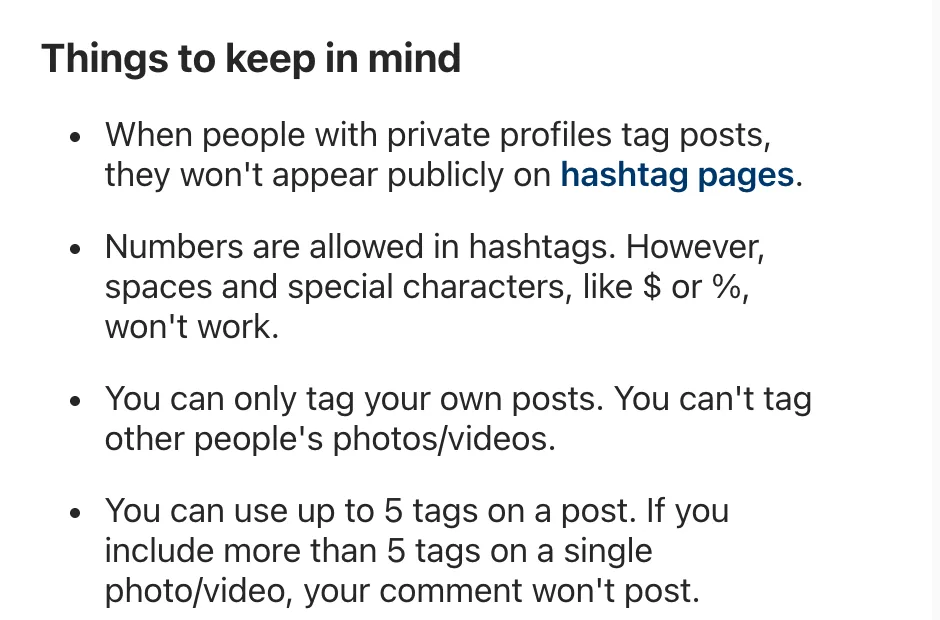
The Instagram hashtag limit is 5 hashtags per caption, on posts and reels. Instagram’s creators account announced it on Threads on 18 December 2025 and rolled it out gradually. Until then the max hashtags on Instagram was 30. Instagram’s help page on hashtags now says you can use up to 5 tags on a post.
Here’s what that means in practice:
- Posts and reels: the same cap covers both. If you were wondering how many hashtags to use on Instagram reels, it’s the same 5.
- The rollout: the hashtag limit Instagram announced went out gradually, so you’ll still see older posts carrying 20 or 30.
- Comments: the help page says that if you include more than 5 tags on a single photo or video, your comment won’t post. A wall of tags in the first comment won’t go up either.
- The reason: Instagram said that fewer (up to 5), more targeted hashtags “can improve both your content’s performance and people’s experience on Instagram.”
- The name: people search for it as the Instagram tag limit or the IG hashtag limit. It’s about # hashtags, not @ mentions of people.
The Instagram hashtag limit also ended a small industry. Tag generators, rotating tag banks and the copy and paste blocks in everyone’s notes app all existed to fill 30 slots.
5 slots don’t need tooling.
Hashtags stopped being a reach tool before the cap
Hashtags on Instagram had already stopped driving reach before the Instagram hashtag limit arrived. They’re labels now. They help search and recommendations work out what your post is about, and that’s about it. 2 changes did it: hashtag following went away in December 2024, and Instagram’s own ranking explainer doesn’t list hashtags as a signal.
- Following a tag is gone: Instagram said in November 2024, “We’re removing the ability to follow a hashtag on Instagram.” By December it was done, so tagged posts no longer land in strangers’ feeds through a followed tag.
- Ranking doesn’t mention them: Adam Mosseri’s Instagram Ranking Explained walks through Feed, Stories, Explore and Reels. Your activity, information about the post and your history with the person who posted are all in there. Hashtags don’t come up once.
- Search reads everything else: captions, on screen text, audio and the video itself.
So tags are metadata. Useful metadata, worth 2 minutes. Not worth a spreadsheet.
2019: a discovery channel
- 30 tags on every post
- People followed tags in their feed
- Tag feeds sent real new viewers
- Tag research tools were worth paying for
2026: a classification label
- 5 tags maximum in the caption
- Following a tag no longer exists
- Search and recommendations do the work
- Absent from Instagram's own ranking post
What to do about the Instagram hashtag limit now
The fix for the Instagram hashtag limit is small. It isn’t “no more hashtags on Instagram”, it’s fewer and better ones. Clear out the old tag blocks, check your scheduling tool, keep the 5 in the caption, and spend the time you save on the content itself.
- Bin the 30 tag blocks. The notes app lists, the tag banks, the generator. You need 5 lines now.
- Check your scheduler. Some scheduling tools dropped tags past the fifth without telling anyone when the cap rolled out. Count the tags on a live post, not on the draft.
- Keep tags in the caption. Instagram has never confirmed a reach difference between the caption and the first comment, and with the Instagram hashtag limit at 5 there’s nothing left to hide. A first comment also depends on an automation firing after you publish. When it fails, nobody notices for a week.
- Put them at the end. Tags go after the sentence that does the work. Hiding them behind dots and line breaks is a 2019 habit, and 5 tags at the end of a caption just look like a normal caption.
If your tag list was ever 30 items long, it was never 5 relevant tags plus 25 hopeful ones. It was 25 hopeful ones.
How to pick your 5 Instagram hashtags
Pick 5 Instagram hashtags that describe what’s actually in the post: the product, the place, the category, the format and your own brand tag. Small and specific beats big and popular. And 5 is the maximum number of hashtags on Instagram, not a target. 3 good tags beat 5 padded ones.
Here are the 6 rules I use.
1. Make every tag specific
Use tags a real person would search: the product, the city, the category, the format.
A workable set for a Riyadh coffee roaster is the roaster’s own name, the neighbourhood, the brew method, the city and the category. 5. Written once, reused, changed only when the content changes.
If you can’t explain what a tag is doing there, it isn’t doing anything there.
2. Pick tags by size, not by how popular they look
Tag size decides whether you’re visible or buried. A tag with 400 million posts puts your reel behind everything. A tag with 20,000 posts is small enough that your post sits near the top for a while. Mix 3 small tags with 1 medium one and stop there.
Instagram shows the post count when you search a tag. That number is the only research this needs.
| Tag size | What it usually is | What it does for you |
|---|---|---|
| Under 50,000 posts | Niche, city or product level | You stay near the top long enough to be seen |
| 50,000 to 500,000 | Category level | Some visibility, mostly inside that niche |
| 500,000 to 5 million | Broad category | Buried in minutes, occasional spillover |
| Over 5 million | Generic tags like love or fashion | Nothing useful. Spam and bots live here |
The row people ignore is the last one. Generic tags are how a comment section fills up with bot accounts, and that’s a real cost.
3. Match the tag to what’s in the video
Tags are classification, so they should describe the content, not the audience you wish you had. If the reel shows a flat white being poured in Jeddah, tag the coffee and the city. Tag a fashion week you didn’t attend and the post gets shown to people who leave straight away.
That’s the one way hashtags can still actively hurt you. A post that doesn’t deliver to the people it’s shown to starts the next one from a worse place.
It’s the same logic as contextual advertising on the paid side. Match the message to the context and everything downstream gets cheaper.
4. Check a tag before you use it
Search the tag first. Instagram’s help page on unsearchable hashtags says a hashtag may not be searchable if the content tied to it keeps breaking its Terms of Use or Community Standards.
If the tag page shows no recent posts or a warning, drop it. It takes 10 seconds.
5. Keep 1 branded tag, for collection, not reach
A branded hashtag is a filing system. It collects customer photos, campaign entries and user content in one place you can find later. Nobody discovers a brand through its own branded tag, so don’t measure it that way.
Where it earns its keep is sourcing. When you run micro-influencers, the tag is how you find every post from a campaign in one search, months later, when you want it for an ad.
1 tag. Short, easy to spell, not already used by something embarrassing.
6. Don’t fill all 5 for the sake of it
What is the optimal amount of hashtags? Whatever’s left once you’ve cut the vague ones. The ideal number of hashtags for Instagram is often 3 or 4, and that’s fine.
An empty slot costs nothing. A wrong tag shows your post to the wrong people.
Where the effort goes instead
Hashtags on Instagram take 2 minutes. The first second of a video decides whether a reel travels, and the caption decides whether it gets saved and found in search. Instagram ranks on what people do with your post, so the hook, the caption and the audio are where your hour should go.
- The hook: the first second has to tell people why they should keep watching.
- The caption: write it like a search result. Say what it is, where it is and who it’s for in the first line. That’s Instagram SEO in one sentence.
- The audio and on screen text: Instagram reads those too, so say the thing out loud in the video as well.
It’s far duller than a tag strategy. It’s also what moves the numbers.
What I’d do on a paid account
On paid accounts I treat the Instagram hashtag limit as housekeeping. 5 relevant tags, written once per content pillar, then left alone. The hours go into creative volume and paid distribution, because a reel that works organically is usually the cheapest ad you’ll run that month.
Organic reach on Instagram is a test bench, not a growth channel. It’s the same shift that turned Facebook marketing into a paid channel with a page attached.
When a reel earns saves and sends on its own, put money behind it. It usually stays cheap.
Not sure whether your Instagram problem is really a hashtag problem? Talk to me.
Questions people actually ask
How many hashtags can you use on Instagram?
5 per caption, on posts and reels. Instagram's creators account announced the cut from 30 to 5 on 18 December 2025 and rolled it out gradually. Instagram's help page now says you can use up to 5 tags on a post, and that a comment with more than 5 on a single photo or video won't post.
How many hashtags should I use on Instagram in 2026?
5 or fewer. 5 is how many hashtags are allowed on Instagram per caption, and fewer is fine. 3 specific tags that describe what's in the content will do more than 5 vague ones. Pick the product, the place and the category before anything broad. And no number of tags will rescue a reel nobody watches past the first second.
Is there a hashtag limit on Instagram comments too?
Yes. Instagram's help page says that if you include more than 5 tags on a single photo or video, your comment won't post. So moving a wall of tags into the first comment isn't a way around the cap. Keep your 5 in the caption, where they don't depend on an automation firing after you publish.
Did Instagram really remove following hashtags?
Yes. Instagram said in November 2024 that it was removing the ability to follow a hashtag, and the option was gone by December 2024. Tagged posts no longer land in anyone's feed through a followed tag. You can still add hashtags and search them, and recommendations in Feed, Explore and Reels do the rest.
Do hashtags still help Instagram reels get reach?
Barely, and not the way people think. Tags help Instagram work out what a reel is about, which feeds recommendations. They don't push a reel into a tag feed full of new viewers the way they did in 2019. What people do with the reel, like watching it through, sending it and saving it, decides whether it travels.
What replaced hashtags for getting found on Instagram?
Search and recommendations. Instagram reads captions, on screen text, audio and the video itself to work out what a post is about. So a clear spoken sentence and a plain, keyword rich caption do more for discovery than a list of tags. It's closer to SEO than to the hashtag playbook from 2019.